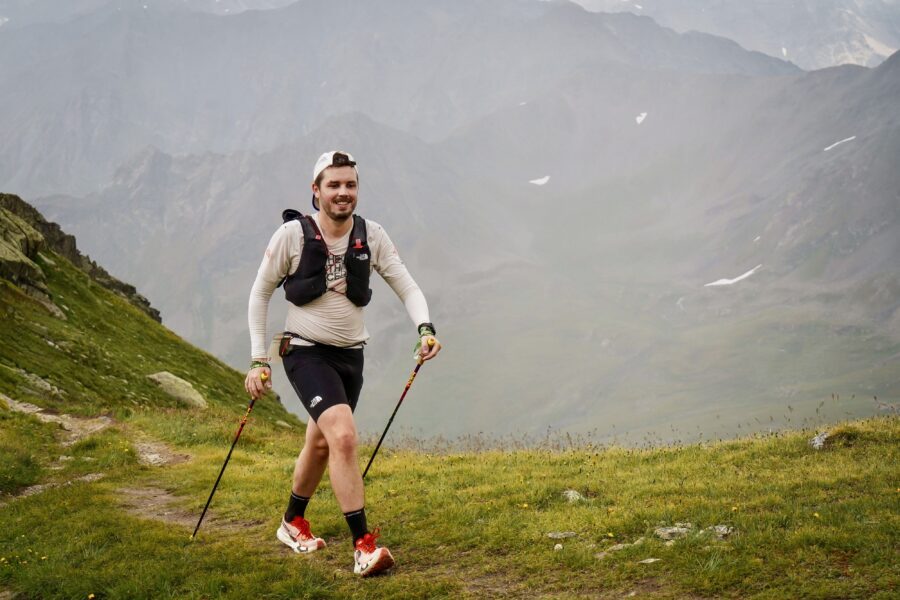
This is a key element on mountain running, pacing yourself.
You know that the easiest is to start hard and feel like a superhero in the first ⅓ of the climbs right? And then… probably crawl to the top. The hard thing to do is to start slow and finish strong… and that hard thing to do, it’s the most efficient way to arrive faster to the top.
When you slow down on a climb your speed can decrease so much that the difference you gain in the beginning gets totally lost towards the end.
The ideal situation is to know the climb, so you can pace yourself based on the length that you already know, but this is not necessarily the rule for everybody. At least it’s important to know the length of the climb, not in distance but in elevation gain, ideally also to know the highest point.
Knowing the highest point and or total elevation of the climb, divide it on 3 sections and pace yourself in each section.
Let’s say this is a 900 meters climb or 2700 ft of climbing, then divide it on 3 sections of 300 meters of 900 ft.
The first section has to feel easy, unless you’re going for your PR, remember that every bit of energy you save in this first section you will thank the last one. Set your watch to see the elevation you’re doing (forget about distance) and make sure to know how much you have left to the top. Pace yourself slower than what you know you want to run at the end and make sure to fuel accordingly to the duration of the climb.
In the second section you will increase intensity, this means that your pace should increase a little bit from the first section but not all out, keep following your climbing pace and make sure to don’t go all out, keep fueling and hydrating.
Then the last section, here’s where you should go all out, as if there was no tomorrow. Your pace will probably be the same as the second section but the intensity will be higher, yeah because you’re more tired, it’s normal but that’s the key. If you keep your pace you’re doing an awesome job, if you’re increasing your pace then you’re crushing it. In general if you’re really pacing yourself well you should be able to keep up the same pace of the second section until the summit without slowing down, this is why it’s key to take it easier on the first ⅓ of the climb, to close strong.
It takes a couple of try to figure it out, of course it doesn’t come right the first time, but you will get there, just be smart and remember that the goal is to finish strong, not to finish crawling at the top.
What’s your secret to crush it on the climbs?