The 100 Mile Endurance Run
Just a quick intro to tell you who I am: my name is Max Keith, and I’m a trail and ultrarunner and one of Vert.run’s co-founders. In addition to all the other hats I wear at Vert.run, I’m also a Vert.run coach and love guiding my athletes toward their goals…especially 100 mile ones. I hope that this 100 training plan guide is here to help you understand what it actually takes to prepare for one.
100 Mile Training Plan: What Your Training Should Include
Training for a 100-mile ultramarathon is not just about running more. A good 100-mile training plan should help you build the aerobic base, durability, fueling habits, climbing strength, and fatigue resistance needed to keep moving for a very long time.
Most runners will need a combination of base building and race-specific training. For many athletes, that means 6 to 12 weeks of general preparation followed by 12 to 16 weeks of focused 100-mile training.
Your plan should include:
- Consistent weekly volume built gradually over time
- Long runs focused on time on feet, terrain, and fueling practice
- Back-to-back long runs to prepare for running on tired legs
- Hill or vert-specific work based on your race profile
- Strength training to improve durability
- Race-day nutrition and hydration practice, ideally using a fueling plan you have already tested in long runs
- Some night running if your race will go through the night
- A proper taper before race day
The goal is not to complete one heroic training run. The goal is to stack enough consistent weeks that your body, legs, stomach, and mind are ready for the full distance.
Not sure where to start with 100 mile training?
Vert.run has training plans and coaching built for real life. Start your free trial today.


How Long Does It Take to Train for a 100 Miler?
Most runners should give themselves at least 16 to 24 weeks to train specifically for a 100-mile ultramarathon, assuming they already have a consistent running base. If you’re newer to ultrarunning, coming back from injury, or stepping up from shorter distances like 50K or 100K, you may need a longer runway.
A good 100-mile build usually has two parts: a base-building phase and a race-specific phase. The base phase helps you build consistency, durability, and general aerobic fitness. The race-specific phase prepares you for the actual demands of your event: terrain, elevation gain, long climbs, descents, heat, altitude, night running, fueling, and time on feet.
As a general guideline:
- If you already run consistently and have ultra experience, 16 to 20 weeks may be enough
- If you’re stepping up from a 50K or 50-mile race, 20 to 24 weeks is usually more realistic.
- If this is your first ultra or your running base is inconsistent, plan for a longer build before starting a specific 100-mile plan
The more specific your race is, the more specific your training needs to be. A flat 100 miler, a mountain 100 miler, and a hot race with long exposed sections should not be trained for in exactly the same way.
100 Mile Training Plan Structure by Phase
A simple 100-mile training structure can look like this:
Phase |
Focus |
What matters most |
|---|---|---|
| Base building | Consistency, aerobic fitness, strength | Build weekly rhythm, easy volume, strength, and durability |
| Early specific training | Long runs, hills, fueling | Start practicing terrain, climbing, descending, and race-day nutrition |
| Peak training | Back-to-backs, time on feet, race simulation | Practice running tired, fueling under fatigue, and long efforts on similar terrain |
| Taper | Recovery, sharpness, confidence | Reduce volume while keeping the body familiar with race effort |
You do not need to be logging huge weeks right away. That is one of the most common mistakes runners make when they sign up for their first 100 miler. The early work should make you more durable, not exhausted. The big race-specific sessions come later, once your body is ready to absorb them.
A good plan should also match your race. If your 100 miler has long climbs, your training needs sustained climbing or climbing substitutes. If your race is flatter and runnable, your training should include more steady running and efficiency work. If your race is technical, your plan should include time on similar terrain, not just miles on smooth roads.
Base Building for 100 Miles: How Many Weeks and How Many Miles?
Most athletes underestimate how long the base-building phase should be for a 100 miler. For a 50K, 4 to 6 weeks of base may be enough. For 100 miles, you usually want 8 to 12 weeks minimum, and if you have the time, leaning toward 12 is the smarter choice.
The goal of base building is not just to get fit. It is to get durable. Fitness can come quickly. Durability, the kind that holds up deep into the second half of a 100-mile race, takes much longer to build. Tendons, ligaments, connective tissue, feet, hips, and calves all adapt more slowly than your cardiovascular system. Rushing this phase is one of the easiest ways to arrive at a 100 miler fit enough to start, but not durable enough to finish well.
In terms of weekly volume during base building, you are not looking for big numbers right away. If you are early in your build or coming back from a period of lower training, starting at 4 to 5 hours per week is completely fine. Build gradually toward 6 to 9 hours over the course of the phase. More important than hitting a specific number is consistency.
Eight weeks of 7 hours per week, every week, without gaps, is more valuable than a block that averages 10 hours but includes two weeks where you barely train because the load was too hard to absorb.
Not all of those hours need to be running. The bike, for example, can be a very useful tool during base building. Cycling helps build your aerobic engine and keeps your legs moving without the same impact as running. For athletes who are building volume carefully, managing a niggle, or trying to reduce pounding during the base phase, replacing one or two weekly runs with a bike session can be a smart move.
During this phase, your training should usually include easy aerobic running, two strength and core sessions per week, regular strides to keep your running economy sharp, and one weekly long run that stays controlled. You are not trying to do your longest run yet. You are building the engine and durability that will support the harder work later.
One of the clearest signs your base building is going well: you finish most weeks feeling like you could have done a bit more. Not destroyed. Not barely recovered. Like there was something left in the tank. That feeling is not a sign you are undertraining. It is a sign the volume is landing correctly and your body is absorbing it.
If you are coming into your 100-mile build after a recent race, give yourself at least 3 to 4 weeks of genuine recovery before starting a focused base-building block. Trying to build on a body that has not fully recovered is not base building. It is accumulated fatigue with a better name.

Weekly Volume and Time-on-Feet Targets by Training Phase
One of the most common questions athletes ask when starting a 100-mile training block is: how many hours should I be running each week?
The honest answer is that it depends on your background, race profile, durability, schedule, and training history. But for most runners, time is a better metric than mileage. A 3-hour run in the mountains with 1,500 meters of climbing is completely different from a 3-hour run on flat roads, but both still require three hours of movement, fueling, focus, and recovery.
As a general framework:
Phase | Weekly moving time | Main goal |
| Base building | 5 to 7 hours | Build consistency, aerobic fitness, strength, and durability |
| Race-specific training | 8 to 12 hours | Build long runs, terrain specificity, fueling practice, and back-to-backs |
| Peak weeks | 10 to 14+ hours | Practice race-specific fatigue, time on feet, and long efforts |
| Taper | 50 to 70% of peak volume | Absorb the work and arrive fresh |
These are guidelines, not rules. Some athletes can prepare well on less if they are consistent, durable, and experienced. Others may need more total time because their race is more technical, more mountainous, or more demanding.
During base building, most of your running should feel easy. This is also a good window to include short strides, short hill sprints, or controlled speed work because the overall training load is still manageable.
As you move into race-specific training, the emphasis changes. The long runs get longer, back-to-back weekends become more important, and the intensity becomes more specific. Instead of chasing fast workouts, your quality work should start to look more like race effort: sustained climbing, steady running on tired legs, long descents, and controlled efforts late in long runs.
Build in a deload week every 3 to 4 weeks where you reduce volume. Adaptation happens during recovery, not during the weeks where you force more load into the system.
Sample 100 Mile Training Week
Day |
Session |
Purpose |
| Monday | Rest or mobility | Absorb the weekend load |
| Tuesday | Easy run with strides | Build easy volume and keep running economy sharp |
| Wednesday | Strength + easy run or cross-training | Improve durability without forcing too much impact |
| Thursday | Uphill intervals, steady effort, or race-specific workout | Build climbing strength or sustained race effort |
| Friday | Easy run | Add low-stress aerobic volume |
| Saturday | Long run | Practice time on feet, terrain, fueling, gear, and pacing |
| Sunday | Second long run or easy run | Build fatigue resistance and practice running on tired legs |
This is not a fixed prescription. It is a structure. The details should change based on where you are in the build. Early in training, the Sunday run might be short and easy. Later, it may become a proper back-to-back long run. Early in training, strength work may happen twice per week. Later, it may drop to once per week so you can absorb the bigger running load.
Long Run Structure: Why Back-to-Back Runs Matter for 100s
At the 50K distance, your long run is usually one big day per week. At 100 miles, one long run per week is often not enough to prepare your body for what it will face late in the race. That is where back-to-back long runs come in.
A back-to-back is exactly what it sounds like: two longer efforts on consecutive days. The second run does not need to be as long as the first, but it should be long enough to simulate running on tired legs.
This matters because in a 100 miler, you will be moving after your legs have already absorbed 12, 15, 18, or more hours of effort. No single long run fully replicates that feeling. Back-to-backs teach your body and mind how to keep moving when the easy freshness is gone.
A practical structure for back-to-back runs during the race-specific phase:
- Day 1: 3 to 5 hours at easy to moderate effort, ideally on terrain similar to your race
- Day 2: 2 to 4 hours at easy effort, focused on time on feet, nutrition, and controlled movement
The second day is not about performance. It is about practicing patience, fueling, and decision-making on tired legs.
Ideally, these two runs happen on consecutive days. If your schedule does not allow that, a longer midweek run followed by your weekend long run can still help. The key is accumulating meaningful time on tired legs without forcing one single massive run that takes too long to recover from.
Back-to-backs are also where it really matters to test your gear and nutrition. Use the same pack, shoes, bottles, poles, layers, foods, gels, and electrolyte strategy you plan to race with. Day 2 of a back-to-back is one of the closest simulations of late-race conditions you will get in training. If your nutrition falls apart on hour 3 of a tired second-day run, you want to find out then, not deep into race day.
Start with one smaller back-to-back block early in your race-specific phase, then build toward two or three bigger blocks. Your biggest back-to-back should usually happen 4 to 5 weeks before race day. Do not try to force a huge one in the final 3 weeks. Recovery takes longer than most athletes expect.

Strength and Elevation Training When You Don’t Have Hills
Not everyone who signs up for a mountain 100 miler lives near mountains. If you are training in a flat city for a race with major elevation gain, you need a strategy.
First, understand what your race actually demands. Look at the total elevation gain, the longest climbs, the longest descents, the altitude, the terrain, and whether the race is mostly runnable or mostly hiking. A 100 miler with 4,000 meters of climbing is not the same as one with 8,000 meters. Your training should reflect that.
Stairs, Stairmaster, and treadmill incline work. Repeating stairs, using a Stairmaster, or running on a treadmill at incline is not glamorous, but it can be effective. The muscular demand on your quads, glutes, calves, and hip flexors is much closer to trail climbing than flat running alone. Use these sessions carefully and progressively.
Strength training. For a flat-city athlete preparing for a mountain 100 miler, strength work is not optional. Squats, lunges, step-ups, calf raises, and single-leg deadlifts help build the strength you would otherwise develop from regular climbing and descending. Aim for two sessions per week during base building, then reduce to one session during heavier race-specific training.
Flat intervals and plyometrics. These are not perfect substitutes for climbing, but they are still useful. Short flat intervals, strides, bounding, and controlled plyometric work can improve leg power, stiffness, coordination, and running economy.
Weekend trips to real terrain. If you can get to proper hills or mountains once or twice a month during your race-specific phase, do it. A single 4 to 5 hour day in terrain similar to your race can be more valuable than several generic flat long runs.
Do not neglect downhill preparation. Most flat-city runners think about the climbs, but the descents are often what destroy the legs late in a 100 miler. Extended downhill running creates a lot of eccentric load in the quads. If you have access to even a short descent, use it. If not, strength work becomes even more important.
This is where a structured plan helps. Combining running volume, incline work, strength, and recovery in the right order is hard to figure out alone. Too little specificity and you arrive unprepared. Too much, too soon, and you carry fatigue into the most important part of the build.
Ready to build your 100 mile training plan?
How Long Does It Take to Finish a 100-Mile Race?
100 miles is roughly 160 kilometers. Depending on the race, terrain, elevation gain, weather, altitude, and your experience, that can mean anything from a long day to two full days of continuous movement.
Finishing times vary widely. A fast runner on a flatter course may finish in 14 to 18 hours, while a technical mountain 100 miler can take 30 to 48 hours, depending on cutoffs and race conditions.
That range matters for training. You are not only preparing to cover 100 miles. You are preparing to keep moving for a very long time, manage your energy, fuel consistently, descend on tired legs, and make good decisions when fatigue builds.
For that reason, your long runs should be planned around time on feet, terrain, fueling, and effort. Mileage matters, but time and specificity matter more for 100-mile training.
Setting Goals for Your First 100 Miler
If you are running your first 100 miler, your main goal should be simple: finish healthy, finish proud, and learn as much as possible.
That does not mean you cannot have a time goal or performance goal. But 100 miles is different from shorter races. Small problems can become very big problems when you are out there for a full day or longer. Stomach issues, blisters, heat, cold, altitude, pacing mistakes, headlamp problems, and aid-station decisions can all change the race.
That is why it helps to set A, B, and C goals.
Your A goal might be your ideal race. Your B goal might be a strong finish even if the day gets messy. Your C goal might be to keep moving, solve problems, and finish within the cutoff.
For a flatter 100 miler, especially one with loops, good crew access, and regular aid stations, it can be easier to set a more specific time goal. For a mountain 100 miler, the finish time is harder to predict. Terrain, weather, climbing, descending, and overnight conditions can all change the day.
If possible, talk to runners who have finished your race before. Read race reports. Watch course videos. Look at aid-station spacing, cutoff times, climb profiles, descent profiles, and the sections that tend to break people. The more you understand the course, the more realistic your training and race-day goals will be.
When you train with Vert.run, your plan is built around your race, your goals, your terrain, and your training history. That context matters, especially for a distance where generic plans often miss the details that decide the day.
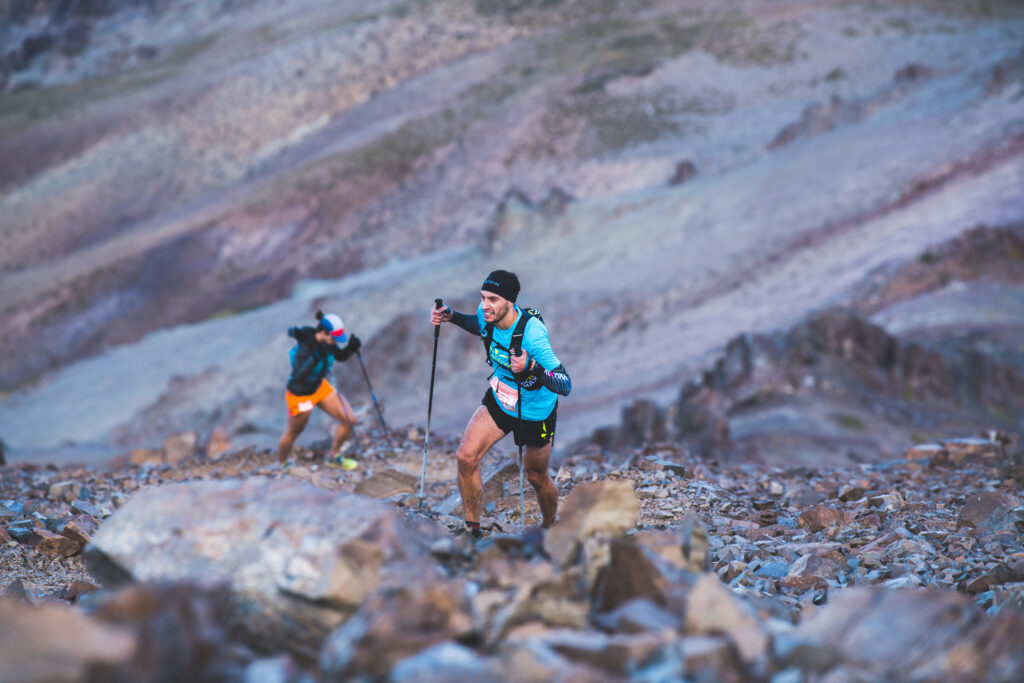
Are You Ready to Train for a 100 Miler?
Before you commit to a 100 miler, it is worth asking one honest question: do you really want to do this?
Not because your friends are doing it. Not because you feel like you are supposed to. Not because 100 miles feels like the next box to check after 50K, 50 miles, or 100K. But because you genuinely want the experience and are willing to commit to the process.
That matters. Training for 100 miles takes time, patience, support, and consistency. It affects weekends, travel, sleep, family life, work stress, strength training, nutrition, and recovery. If the motivation is not really yours, the process gets heavy quickly.
A good baseline before attempting 100 miles is having completed at least a 50K, and ideally a 50-mile or 100K race. You do not need to be fast, but you should have experience being out for many hours, managing nutrition, dealing with low points, and recovering from long efforts.
That said, there is no need to rush. You do not become more legitimate as a trail runner because you run 100 miles. A strong 50K, 50 miler, or 100K can be just as meaningful, and often a better step if your body, schedule, or motivation is not ready for the full distance yet.
The goal is to build a long life in the sport. If waiting another season gives you a better chance of having a positive 100-mile experience, that is not hesitation. That is good decision-making.
What to Do Once You Commit to a 100 Miler
Once you decide to train for a 100 miler, the first step is not to go out and run a huge week. The first step is to understand the race and build the structure around it.
Start with the course. Look at the elevation profile, aid-station spacing, technical terrain, altitude, weather patterns, likely night sections, crew access, pacer rules, and cutoff times. These details should influence how you train.
Then look at your life. How many days per week can you realistically train? How much time can you protect on weekends? Do you have access to hills? Can you strength train? Can you practice night running? Can you travel to terrain that looks like your race?
A few practical steps:
- Talk to runners who have finished the race before
- Read race reports and study the course profile
- Volunteer or pace at a 100 miler if you can
- Choose a race that matches the terrain you can train on, especially for your first 100
- Commit early enough to give yourself time to build gradually
- Tell the people close to you what the training will require
- Get a plan that matches your race date, terrain, and training history
Choosing the right race matters. If you live somewhere flat and do not have easy access to technical trails, a highly mountainous 100 miler may not be the best first choice. That does not mean you can never do it, but it does mean you will need a smarter plan and more intentional race-specific preparation.

Race-Specific Training: Terrain, Vert, Fueling, and Gear
The closer you get to race day, the more your training should look like the race.
That does not mean every run has to be hard or long. It means the important sessions should prepare you for the problems your race will actually ask you to solve.
If your race has long climbs, include sustained uphill work or incline substitutes. If your race has long descents, prepare your quads with downhill running and strength training. If your race is hot, practice heat management and hydration. If your race goes through the night, train in the dark. If aid stations are far apart, practice carrying more fluid and calories.
Test your carbohydrate intake, sodium intake, hydration, caffeine, foods, gels, chews, bottles, soft flasks, pack, poles, shoes, socks, and layers.
Use training to answer the questions you do not want to answer during the race:
- How many carbs can I take per hour?
- What happens to my stomach after 5 or 6 hours?
- Can I climb well after several hours of running?
- Do my shoes still work when my feet swell?
- Can I descend when my quads are tired?
- Does my headlamp setup work on technical terrain?
- What do I actually want to eat when I am tired?
A 100 miler rewards the athlete who solves problems early. Training is where you solve them.
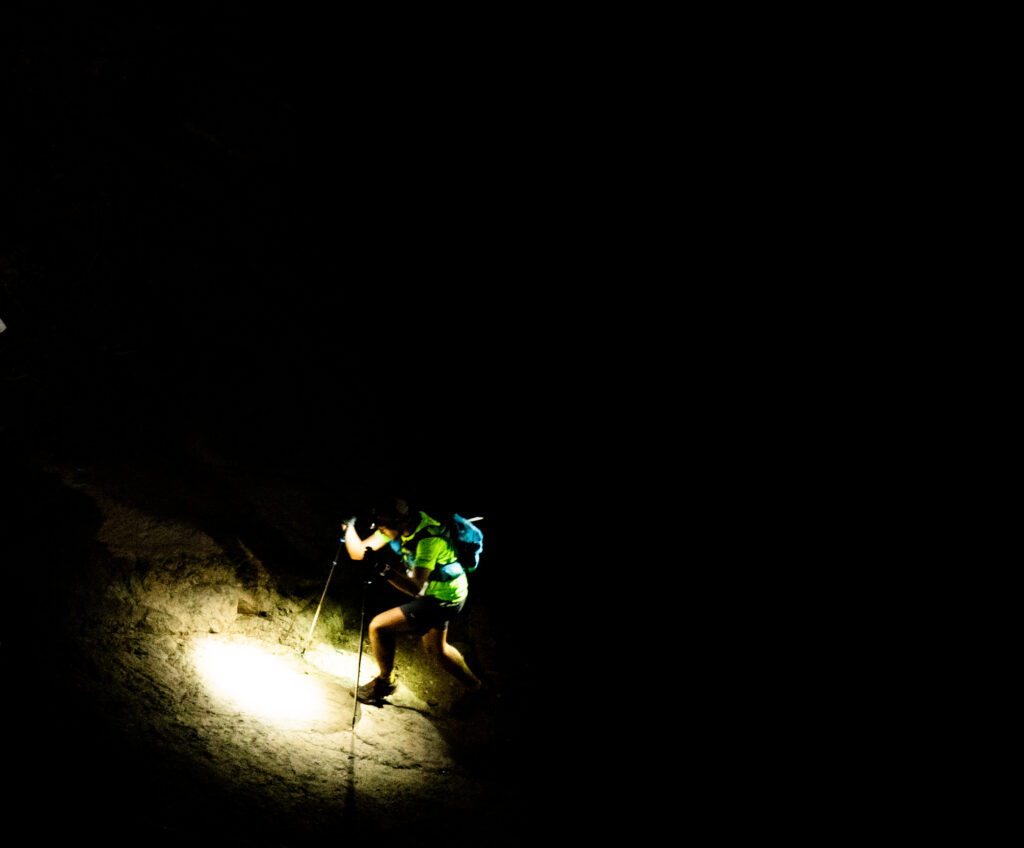
Night Running: How to Train for Running in the Dark
Almost every 100 miler involves at least one night. Many runners will see two. Yet night running is often undertrained.
Running in the dark changes the experience. Your depth perception changes, your pace usually drops, your body temperature can fall, your mood can shift, and decision-making becomes harder when fatigue and darkness overlap.
Schedule night runs during your race-specific phase. This means going out after dark with your race headlamp, on terrain that requires real attention. A lit bike path is better than nothing, but it does not fully prepare you for technical trail movement under a headlamp.
Test your gear. Know your headlamp battery life. Carry a backup light. Practice changing batteries or swapping lights. Some runners prefer a headlamp on the head plus a second light at the waist for better depth perception on technical descents. Test that before race day.
Practice pacing in the dark. It is easy to either overrun because you cannot see the full climb ahead, or slow down too much because everything feels unfamiliar. Check in with effort often. Learn what sustainable movement feels like at night.
The hardest mental window in many 100 milers comes between 2 and 5 a.m. Fatigue, cold, darkness, and low energy can combine quickly. The more familiar the dark feels before race day, the less power that window has over you.
Tapering for a 100 Miler
By the time you reach the taper, the work is done. The goal is no longer to gain fitness. The goal is to absorb the training and arrive at the start line fresh.
For a 100 miler, most runners should taper for 2 to 4 weeks. The exact length depends on your training load, experience, durability, and how hard your peak block was. If this is your first 100 miler, it is usually better to err on the side of arriving slightly more rested than slightly overtrained.
During the taper, reduce volume gradually while keeping some light structure in the week. Easy runs, short strides, and small touches of race effort can keep the legs feeling normal without adding fatigue.
Do not try to make up missed training during the taper. That is one of the biggest mistakes you can make. One extra long run or one panic workout will not add meaningful fitness, but it can absolutely take away freshness.
Use the taper to organize logistics, dial in gear, review the course, plan aid-station strategy, confirm crew or pacer details, and make sure your nutrition plan is realistic.
Get to your start line ready.
Tell us your race date and goals. Vert.run will take it from there.
Notable 100 Mile Races Around the World
There are 100-mile races all over the world now, but a few have become especially iconic in trail and ultrarunning.
UTMB Mont-Blanc is one of the most famous 100-mile races in the sport. The course loops around the Mont Blanc massif, passing through France, Italy, and Switzerland, with major climbs, long descents, huge crowds, and a deep international field.
Western States 100 is one of the oldest and most historic 100-mile races in North America. The race runs from Olympic Valley to Auburn, California, and is known for its heat, canyons, runnable sections, and competitive lottery.
Hardrock 100 is one of the most demanding mountain 100s in the world. The race takes place in Colorado’s San Juan Mountains and includes high altitude, technical terrain, major climbs, and a very selective entry process.
Diagonale des Fous on Réunion Island is known for brutal terrain, long climbs, technical trails, and an atmosphere that feels like the whole island is part of the race.
Tarawera 100 Mile in New Zealand offers a different kind of 100-mile experience, with strong organization, beautiful trails, and a race environment that has become a major part of the international ultra scene.
Patagonia Run 100 Mile in Argentina is one of the standout 100-mile options in South America, with a beautiful setting, strong organization, and a course that brings runners into the landscapes of northern Patagonia.
You do not need to choose the most famous race for your first 100 miler. In many cases, the best first 100 is the one that matches your terrain, gives you a realistic training runway, and allows you to prepare well.

Tapering Phase for a 100 Mile Endurance Run:
By the time you reach your taper, all the hard work is already done and you will probably start to feel tired, sleepy and hungry all the time. That’s normal. Now is the time to start taking your foot off the gas, and to start decreasing your overall load. When tapering for a 100 miler, you should decrease your overall load week by week–gradually.
The idea during your 100 mile taper is to keep the legs moving nicely while adding back in some short efforts (like light stride sessions) into your training to get the legs feeling the pep again. (Again, I know I’m biased…but here’s where our Vert.run 100 miler training plan comes in handy: follow the plan, and we’ll make sure you’re tapered nicely for race day.)
Tapering is different for everybody, and for something like a 100 miler, it can be anything from 4 weeks out from race day up to 10 days for the most advanced runners.
Anyhow, if you don’t have much experience running 100 miles and you did all your work on the previous phases, please err on the side of caution and do a long taper just to make sure you arrive at the start line feeling fresh and ready to go the distance.
Finally, even though nowadays there are plenty of 100 milers all over the world (with most of them being in the US), here we leave you with a short list of some of the most epic, iconic 100 mile races around the globe. Even if they’re not next on your list right now, they’re great material for inspiration during your training–watching some YouTube videos about them is a great way to stay motivated!
Want this plan structured week by week in the Vert app?
Prefer a personalized plan built around your schedule and race? Work with a Vert coach
Frequently Asked Questions About Training for a 100 Miler
How do I know if I’m ready to run a 100 miler?
A good baseline is having finished at least a 50K, and ideally a 50-mile or 100K race, before attempting 100 miles. You should also have several months of consistent training, experience with long runs, and a real desire to take on the distance. If you are doing it only because you feel pressure, it is worth waiting.
How many weeks do I need to train for a 100 miler?
Most runners should plan for 16 to 24 weeks of focused training, assuming they already have a running base. If you are newer to ultras, coming back from injury, or stepping up from much shorter distances, give yourself a longer runway.
What is the longest run I should do before a 100 miler?
There is no single magic longest run. For most runners, the biggest training stimulus will come from a combination of long runs and back-to-back long runs, not one massive single run. A 4 to 6 hour long run or a back-to-back weekend can be more useful than forcing one extremely long effort that takes too long to recover from.
How many miles per week should I run for a 100 miler?
Think in time first, not mileage. During race-specific training, many runners will build toward 8 to 12 hours per week, with higher-volume peak weeks for more experienced athletes. The right number depends on terrain, elevation gain, experience, durability, and available time.
Should I do back-to-back long runs?
Yes, for most 100-mile training plans, back-to-back long runs are one of the most useful tools. They prepare you to move on tired legs without forcing one single huge long run. Start conservatively and build gradually.
Do I need to train at night?
Almost certainly, yes. Most 100 milers involve at least one night, and many runners will see two. Practice running in the dark with your race headlamp, backup light, layers, and nutrition setup before race day.
Should I do strength training while preparing for a 100 miler?
Yes. Strength training helps build durability and supports the muscular endurance you need late in a 100 miler. Aim for two sessions per week during base building, then reduce to one session per week as your running volume increases.
Do I need a crew or pacers for a 100 miler?
Not always, but they can help a lot if your race allows them. A good crew can help you stay on top of nutrition, gear, pacing, and decision-making. Pacers can be especially useful in the second half of the race when fatigue, darkness, and low points become harder to manage.
Build Your 100 Mile Training Plan with Vert.run
A 100-mile training plan should not be generic. Your race date, terrain, elevation gain, experience, weekly availability, injury history, and goals all matter.
Vert.run builds your plan around the race you are actually training for, then helps you stay consistent when life, fatigue, travel, and missed sessions get in the way.
Tell us your race date and goals. We’ll help you get to the start line ready.
Want this plan structured week by week in the Vert app?
Prefer a personalized plan built around your schedule and race? Work with a Vert coach