


Free tool
On trails, the trail decides your pace. Enter your easy pace on flat ground and the route into this trail running pace calculator, and see what pace and finish time to expect, plus the route’s Mountain Index.
Use this to know what to expect, then run it by effort. Climbs, heat, night, altitude and how you feel on the day will move your pace around. That’s normal on trails.
It does two separate things.
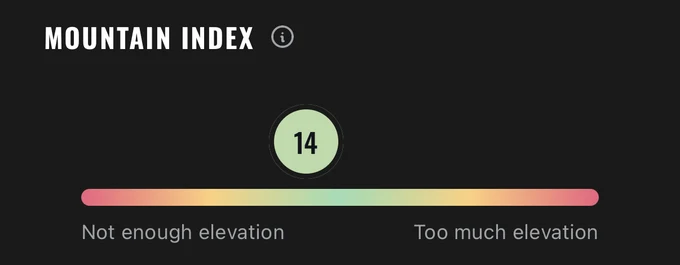
It describes the route with the Mountain Index. The Mountain Index (MI) is metres of climbing divided by kilometres. A 50K with 2,500 m of climbing has an MI of 50. It tells you what kind of race you’re preparing for. In Vert we use three levels: Flat (0–10), Hills (11–40) and Steep (above 40). It doesn’t predict time on its own. We explain it in full in How much elevation should you train for an ultra?
It estimates time with flat-equivalent distance. To turn climbing into time, the calculator uses a simple rule many trail runners and race organisers use: every 100 m of climbing costs about as much as 1 extra kilometre on the flat. It multiplies that distance by your easy flat pace, adds time for rough terrain, and adds a little extra for races past the marathon, because everyone slows down as the hours pile up. You get a range rather than one number, because a single number on trails is false precision.
Climbing is the obvious reason, but not the only one. You hike the steep bits, you slow down on technical descents, you stop at aid stations, and your footing changes every few metres. That’s why a runner who does 5:30/km on the road can be happy averaging 8:00/km or slower on a mountain 50K. Comparing your trail pace to your road pace is the fastest way to feel bad about a run that went well.
In the Vert.run app
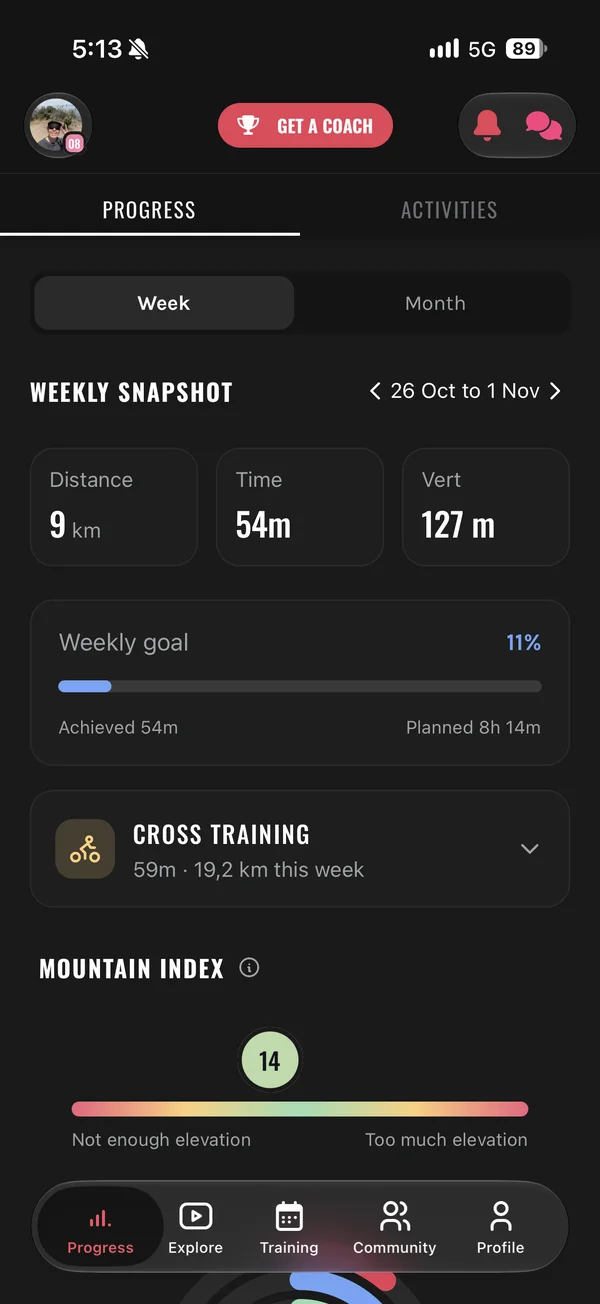
In the Vert.run app, every synced run shows its Mountain Index, and your plan uses your race's MI to set a weekly climbing range. You see each week whether your training has the right amount of climbing for your race, from Flat to Steep.
On race day
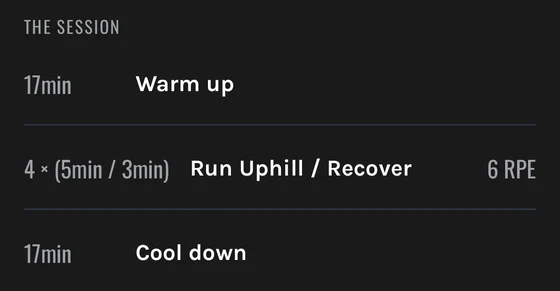
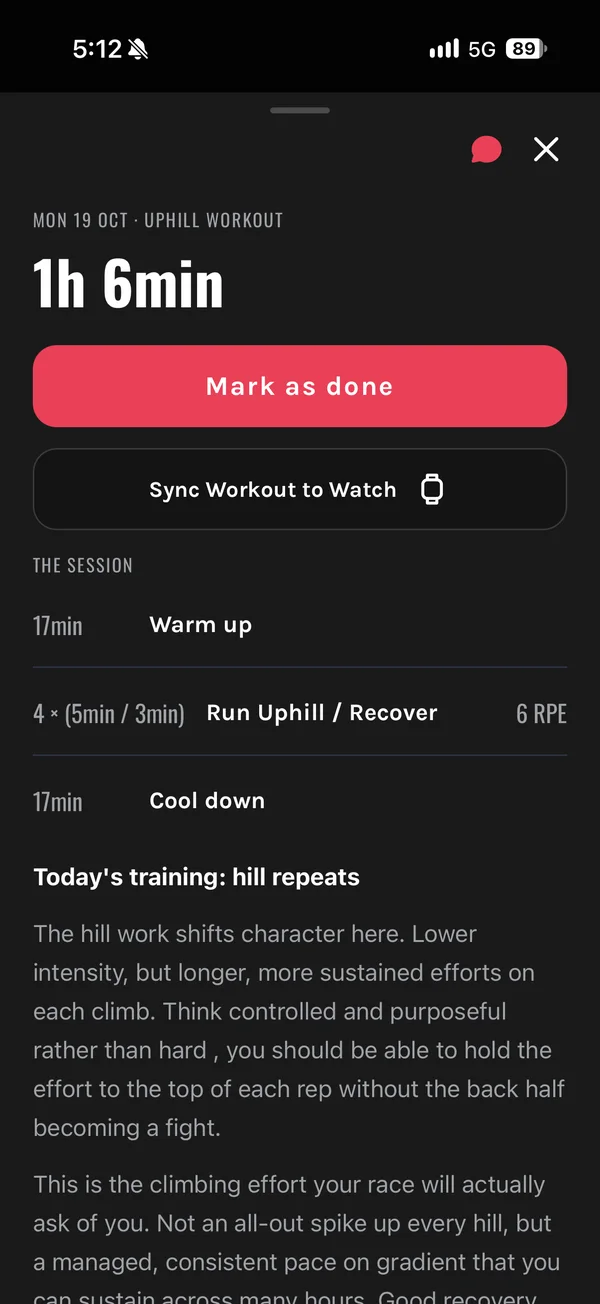
Use the range to plan: how long you’ll be out, how much food and water you need, when you’ll need a headlamp. On the day, run by feel. We coach with RPE, the rate of perceived effort, because the same effort can look like 6:00/km on a flat path and 15:00/km on a steep climb. If you chase a pace on a climb, you pay for it later.
Vert Pro · Plan for the route, not the pace
Get a plan built around your race, the terrain you train on and the time you have, reviewed by a coach.
Start your free trial7-day free trial · cancel anytime
It doesn’t know how strong a climber you are, how fast you descend, the heat, the altitude, or how long you’ll spend at aid stations. If you already have an ITRA or UTMB index, our trail race time predictor uses your real results and the actual course for a closer estimate.
FAQ
There isn’t one. Trail pace depends on the climbing, the terrain and how long the run is far more than on fitness alone. A better question is whether you finished strong at the effort you planned. Use the calculator to see what’s realistic for a specific route.
On a flat, smooth trail, only a little. On a hilly or technical route, much slower. As a rough guide, every 100 m of climbing adds about as much time as 1 km of flat running, and rough terrain adds 10 to 25% on top.
Divide the elevation gain in metres by the distance in kilometres. 1,500 m of climbing over 30 km is an MI of 50. In the Vert app, every synced run shows its MI, and your plan uses your race’s MI to set a weekly climbing range.
By effort. Pace on trails changes with every climb and descent, so a pace target pushes you too hard uphill and holds you back on the flat. Effort stays the same whatever the terrain.
Yes, as a first estimate, especially if you haven’t raced on trails yet. If you have an ITRA or UTMB index, the race time predictor will be more accurate.
Choosing an app to train for trail races? See how Vert.run compares with Runna for trail and ultra running.
Sessions guided by effort, with your climbing tracked by the Mountain Index. Built around your race, reviewed by a coach. Start with 7 days free.
Start your free trial7-day free trial · cancel anytime