You’ve signed up for a trail race and now you want to know how to predict your trail race finish time. You’ve looked at past results, done some rough math, maybe tried a road running calculator that spat out something that made no sense once you saw the elevation profile. Learning how to predict your trail race finish time is genuinely harder than it looks, and road pace math won’t save you.
This article explains what actually goes into a reliable prediction, and how to use the Vert Race Time Predictor to get a real answer before race day.
Why Trail Race Finish Times Are So Hard to Predict
On the road, pace is everything. You run a 4:30/km half marathon, you can project a full marathon time with reasonable confidence. The course is flat, the surface is consistent, and everyone runs roughly the same race.
Trail running doesn’t work that way.
Two races can share the same distance and look completely different on paper. A 50k with 3,000m of vert is not the same race as a 50k with 800m of vert. A technical single-track course through loose scree runs slower per kilometer than a smooth gravel path. Cut-off times vary wildly because race directors know this. A 50k in the Alps might have a 12-hour cut-off. A fast 50k in the foothills might cut you at 7.
Beyond course profile, there’s you. Your fitness on roads doesn’t translate directly to trail performance. A 3:30 road marathoner who has never trained on vert or technical terrain can arrive at a mountain 50k undertrained in ways their road fitness doesn’t reveal. The reverse is also true: a trail runner with strong vert capacity who has never clocked fast road times can outperform expectations on a mountainous course.
This is why generic calculators built for road running don’t work here. They’re solving the wrong problem.

What Actually Determines Your Trail Race Finish Time
Get these five inputs roughly right and you’ll have a solid picture of how to predict your trail race finish time.
Distance and elevation. These two together give you the real picture of what the course demands. Distance without elevation is half the story on trail. Gaining elevation slows you down in a non-linear way, and descending takes more out of your legs than most runners account for. Two races with identical distance and vert can still run completely differently depending on how that vert is distributed across the course. If you’re building vert fitness without access to mountains, the Vert guide to training for hills without hills covers exactly that.
Course technicality. A GPS file showing the same distance and elevation can represent two very different races depending on whether you’re running runnable gravel road or picking your way through boulders. Real race data, including winning times and average finisher times from previous editions, captures this. Winning time is probably the best single proxy for course difficulty you can use.
Your trail fitness, not your road fitness. The standard fitness signals in trail running are the ITRA Performance Index and the UTMB Index. Both are calculated from your actual race results on certified trail courses. They’re not about pace. They’re about how you perform relative to the field over real mountain terrain. More on these in the next section.
Race day conditions. Heat, mud, and high altitude all add time. A course you previewed in ideal spring conditions will run slower in July heat. Most prediction models don’t account for this directly, but knowing your scenarios (optimistic through conservative) gives you a range that covers typical variation.
Your pacing and execution. Even with a solid fitness profile and accurate course data, going out too hard in the first climb costs you more on trail than it would on road. Your predicted time is only as good as the execution behind it.
─ Vert Pro · Vert Coaching: Designed and approved by expert coaches.
Trust the training.
Then trust race day.
What the ITRA and UTMB Indexes Actually Are
If you’ve done any trail or ultra races in the last few years, you probably have one or both of these scores. Here’s what they mean.
The ITRA Performance Index is calculated by the International Trail Running Association based on your race results in ITRA-certified events. It runs from 0 to 1,000 and reflects your performance relative to the winning time on each course. An index of 400-500 represents a solid mid-pack trail runner. Elite runners sit above 750. It’s course-adjusted, meaning it accounts for distance and elevation, not just finish time.
The UTMB Index does essentially the same thing but draws from the UTMB World Series ecosystem. Any race registered as a UTMB Index race counts, and there are thousands of them worldwide across all distances. If you’ve run a certified trail race in the last couple of years, there’s a good chance you already have a score at utmb.world.
Both indexes are the best single-number answer to “how fit is this runner for trail and mountain terrain?” They’re what race organizers use to set qualification standards, and they’re what the Vert Race Time Predictor uses as your fitness input.
If you don’t have either index yet, it means you haven’t completed enough certified trail race results for the score to generate. That’s common for newer trail runners or road runners who have just crossed over. The path forward is simple: run ITRA-certified or UTMB Index races. Results are added to your profile automatically once the race organizer submits them, so there’s nothing to log on your end. Your index builds over time. In the meantime, the predictor lets you enter custom race details manually, and you can check cut-off times and past average finisher times directly from your race’s results page on ITRA to get a rough sense of where your day might land.
The Best Way to Predict Your Trail Race Finish Time
How to Use the Vert Race Time Predictor
The Vert Race Time Predictor is free to use. Here’s exactly how it works.
Step 1: Enter your runner profile. Name, email, date of birth, and country. This takes 30 seconds.
Step 2: Enter your ITRA and/or UTMB index. You need at least one. Having both improves accuracy because the tool can cross-reference two independent measures of your trail fitness. Find your ITRA index at itra.run. Your UTMB index is at utmb.world.
Step 3: Select your race. Search from a database of real races by name. When you find it, the tool pulls actual race data: distance, elevation, winning time, cut-off time. This is what separates it from a generic calculator. You’re not entering numbers manually or hoping the tool understands what the course actually demands. The race data is already there.
*If your race isn’t in the database (smaller local races, new events), you can enter custom details manually: distance, elevation gain, and estimated winning time.
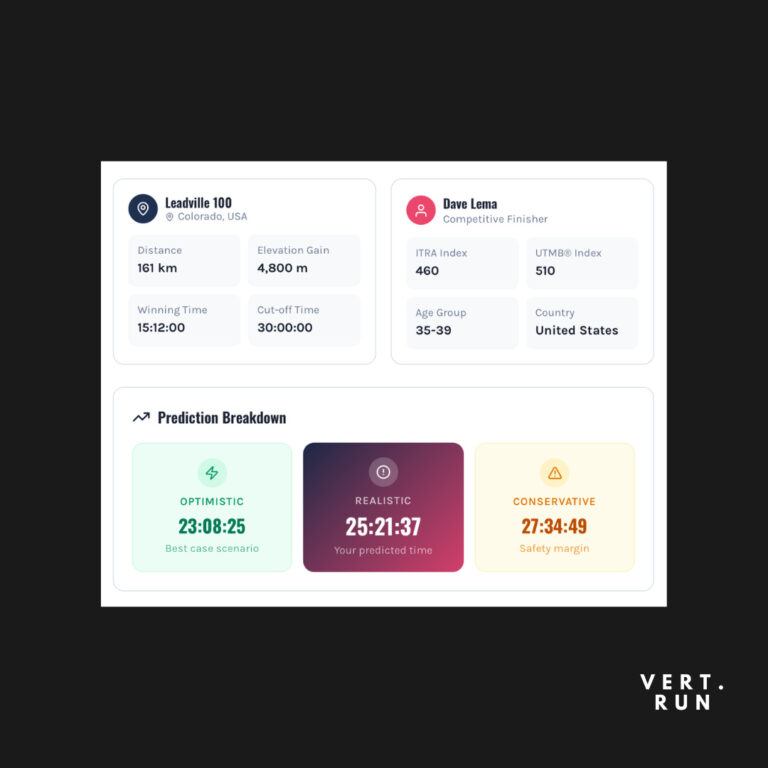
Step 4: Get your prediction. The tool outputs your estimated finishing time, then breaks it down into three scenarios: Optimistic (best case), Realistic (your predicted time), and Conservative (your safety margin). Below that, a Performance Comparison shows your predicted time against the winning time, average finisher time, and cut-off time, so you can see exactly where you land in the field. If you’re comfortably ahead of the cut-off, the tool tells you by how much.
The whole process takes about two minutes.
How to Read Your Results: The Three Scenarios
The predictor doesn’t give you one number. It gives you three.
Optimistic: Everything goes right. You’re in good shape on race day, the weather cooperates, your pacing is clean, and you execute well. This is your ceiling for this course given your current fitness.
Realistic: The expected outcome given your fitness and a normal race day. Use this for planning purposes. This is the number to give when someone asks what time you’re going for.
Conservative: Things get hard. You have a rough patch, the heat catches you, or the technical sections take more out of you than expected. This scenario tells you where your day goes if it doesn’t unfold cleanly. Important: this is also the number to check against the cut-off time.
The result page also shows you how your predicted time compares to the winning time and the average finisher time from past editions. This context matters. Knowing your realistic finish puts you at roughly the 60th percentile of finishers is different from knowing you’re predicted to finish near the cut-off.
How to Use Your Prediction to Actually Plan Your Race
Knowing your predicted trail race finish time is only useful if it changes how you prepare.
Pacing. If you’re targeting an 8-hour finish on a 50k with big vert, rough math gives you something to work with on each major climb and descent. You’re not chasing a specific pace per kilometer. You’re managing effort, but having time targets for major checkpoints keeps you honest and prevents blowing up on the first climb.
Nutrition and hydration. Duration drives fueling. An 8-hour day requires a completely different fueling strategy than a 5-hour day. If your realistic prediction is 9 hours and you’ve been training with a 6-hour mindset, your nutrition plan is wrong for race day. The Vert 100k training guide and 100-mile guide both go deep on fueling for longer efforts, but the principle applies to any race over about 4 hours.
Crew and pacer planning. If your race allows crew access or pacers, your predicted times at checkpoints are the foundation of that plan. Your crew needs to know when to expect you. Your conservative scenario gives them a buffer. Your optimistic scenario tells them not to wait past a certain point.
Checking the cut-offs. Run your conservative scenario against the cut-off times, not your realistic one. If your conservative prediction puts you at the halfway aid station 15 minutes before the cut, that’s not a comfortable margin. That’s a problem to address in training before you show up.
The mental side. A finish time prediction does something that no training plan can fully replicate: it makes the race real before you toe the line. Knowing you’re looking at a 9-hour day, not a vague “somewhere between 7 and 12,” changes how you prepare mentally. You can rehearse the hard patches. You know roughly when darkness hits if you’re running through the night. You know when the suffering is likely to peak and what’s left after that. Most race anxiety comes from the unknown. A realistic number doesn’t remove the hard parts, it just removes the surprise.
For first-time ultra runners specifically, this is the most important use of a prediction. The 50k training guide and trail marathon guide both cover the mental side of managing a long day, but knowing your realistic time range going in takes a lot of the anxiety out of it.
Try the Predictor
The Vert Race Time Predictor is free to use. You need your ITRA or UTMB index and the name of your race.
Get your trail race time prediction at race.vert.run
If the tool tells you something you weren’t expecting, that’s the point. Better to know before race day than to find out on course.

Frequently Asked Questions
What is a trail race time predictor?
A trail race time predictor is a tool that estimates your expected finishing time for a specific trail or ultramarathon course based on your fitness data and the course’s actual profile (distance, elevation, historical winning times). Unlike road calculators, a good trail race finish time predictor accounts for vert and course technicality, not just flat pace.
How do I find my ITRA index?
Go to itra.run, search for your name, and your current ITRA Performance Index will be listed on your profile. The index updates after each certified race result is logged. If you’ve run ITRA-certified events but don’t see a score, the result may not have been submitted yet by the race organization.
Can I use the predictor if I’ve never run a trail race?
The tool requires at least one of an ITRA index or UTMB index, which are generated from certified trail race results. If you have no trail race results yet, the prediction won’t be possible. If you’re training for your first trail race, the best approach is to look at average finishing times from past editions of your specific race and plan from there.
What’s the difference between ITRA index and UTMB index?
Both are trail-specific fitness scores calculated from certified race results, but they come from different organizations. The ITRA index is issued by the International Trail Running Association and covers a broad range of certified races worldwide. The UTMB Index covers any race registered as a UTMB Index race, and there are thousands of them worldwide. If you’ve run a certified trail race in the last couple of years, there’s a good chance it qualifies. Using both indexes gives a more accurate prediction because the tool can cross-reference two independent measures of your trail fitness.
How accurate is a trail race time prediction?
Accuracy depends on how much data is available for your race and how recent your index scores are. For major races with years of results, the tool can generate a High confidence prediction. For newer or smaller events where less race data exists, expect a Medium or Low confidence rating. As a general rule, treat your realistic scenario as a planning target and your conservative scenario as your minimum preparedness floor.
What if my race isn’t in the database?
You can enter custom race details manually: distance, elevation gain, and estimated winning time from past editions. Most race organizations publish results on their websites or on ITRA, so finding winning times from the last edition is usually straightforward.
My predicted finish is much slower than I expected. What should I do?
Trust the data. The most common reason for an unexpectedly slow prediction is that a runner’s trail-specific fitness (measured by ITRA or UTMB index) hasn’t kept pace with their road fitness or their ambition for the race. That gap is fixable with the right training. If your race is still weeks out, the Vert coaches can help you build toward a more realistic target.
Vert.run is a coach-backed trail and ultra running training platform. VertPro gives you adaptive training with coach-designed plans. VertCoaching pairs you directly with a personal coach for weekly guidance.
─ Vert Pro · Vert Coaching: Designed and approved by expert coaches.
Trust the training.
Then trust race day.
Start your 7-day free coaching trial. Cancel anytime.