A trail marathon is still 42.195 kilometers, or 26.2 miles, but that shared distance can be misleading. The training demands are different because the surface, elevation, pacing, gear, fueling, and mental rhythm all change once you leave the road.
On the road, a marathon plan can be built around pace, mileage, and fairly predictable long runs. On trails, those same tools become less reliable. A hilly 90-minute trail run might cover far fewer miles than a flat road run, but it can create a bigger muscular and technical training load. A kilometer with 200 meters of climbing is not the same as a flat kilometer. A descent on loose rock can create more damage in your quads than the climb that came before it.
That is why a trail marathon training plan should be built around time-on-feet, effort, terrain, elevation, downhill resilience, fueling practice, and race-specific decision-making. You are not only preparing to cover the distance. You are preparing to solve the problems the course will create.
Are You Ready to Train for a Trail Marathon?
You do not need to have run a road marathon before your first trail marathon. You do need enough consistency to handle a focused training block without making every week feel like survival.
A good baseline is being able to run comfortably for 80 to 90 minutes at an easy effort, with several months of consistent running behind you. Some experience on uneven ground helps, but it does not need to be mountain terrain. Gravel paths, park trails, rolling dirt roads, forest tracks, and treadmill incline work all count as useful preparation.
If you are coming from road running, your aerobic fitness may already be strong enough. The limiter is usually not your lungs. It is the specific durability you need for climbing, descending, uneven footing, and longer time-on-feet at a lower average speed.
Before you start the plan, ask three practical questions:
- Can I run easily for at least 80 to 90 minutes?
- Can I train consistently for 14 to 18 weeks?
- Do I know what kind of trail marathon I am preparing for: runnable, hilly, technical, hot, high-altitude, or mountain-style?
If you are still deciding whether a trail marathon is the right next step, compare trail running training plans by goal before committing to a specific training block.
─ Vert Pro · Vert Coaching: Designed and approved by expert coaches.
Have a race date?
Tell us and we’ll build your trail marathon training plan around it.
How Long Should a Trail Marathon Training Plan Be?
Most runners should plan for 14 to 18 weeks. Fourteen weeks can work if you already have a solid base and regular trail experience. Sixteen to 18 weeks is better if you are coming from road running, returning from a break, or preparing for a course with meaningful climbing or technical terrain.
The extra weeks are not only for more fitness. They give your body time to adapt to the loads that road running does not fully prepare you for: eccentric quad damage from descents, lateral ankle and hip stability, hiking steep climbs efficiently, carrying hydration, and eating while moving for several hours.
A simple structure works well:
- Weeks 1 to 3: introduction and terrain adaptation.
- Weeks 4 to 8: base building, strength, and hill skill.
- Weeks 9 to 14: race-specific preparation, longer trail runs, gear, and fueling practice.
- Final 2 weeks: taper, logistics, and freshness.
Phase | Weeks | Main Goal | Key Sessions |
Adaptation | 1-3 | Introduce trails, hills, and strength without forcing volume. | Easy trail runs, short hill exposure, strength basics. |
Base | 4-7 | Build consistency, durability, and time-on-feet. | Long run by time, hill intervals, 1-2 strength sessions. |
Specific | 8-12 | Match training to race terrain and logistics. | Race-like long runs, downhill practice, fueling and gear tests. |
Peak / absorb | 13-14 | Build confidence without creating deep fatigue. | Longest trail run or supported weekend, then easier recovery. |
Taper | 15-16 | Arrive fresh, organized, and healthy. | Reduced volume, short strides, gear checks, course review. |
Build the Plan Around Time-on-Feet, Not Mileage
For trail marathon training, time-on-feet is usually a better anchor than weekly mileage. A 10-mile road run and a 10-mile trail run can be completely different sessions if the trail run includes steep climbs, technical descents, heat, altitude, mud, or slow footing.
This matters because many runners accidentally overload themselves when they try to force road-style mileage onto trails. The watch says the distance is lower, so they add more. But the legs are already absorbing more climbing, braking, stabilizing, and hiking than they would on the road.
A beginner-to-intermediate trail marathon build often peaks around 4 to 7 hours of running per week. More experienced runners may handle more, but the right number depends on your training history, race profile, terrain access, durability, and recovery. The plan should progress gradually, with easier weeks built in every three or four weeks.
Road-plan habit | Trail-marathon adjustment | Why it matters |
Weekly mileage target | Weekly time-on-feet range | Trail terrain can make fewer miles a bigger training load. |
Target marathon pace | RPE-based effort | Elevation and footing make pace unstable. |
Flat long run | Terrain-specific long run | Race-day legs need climbing, descending, and uneven ground. |
Aid stations assumed | Carry and practice hydration | Trail aid can be farther apart and slower to reach. |

Weekly Structure for Trail Marathon Training
A good week does not need to be complicated. Most runners need one long run, one hill or quality session, two to three easy runs, one to two strength sessions, and enough recovery to absorb the work.
The long run is the anchor. It should gradually become more specific to your race. If the race is hilly, your long run needs climbing or a substitute. If the race is technical, you need time on uneven ground. If the race has long aid-station gaps, long runs are where you practice carrying fluid and calories.
The quality session should build climbing strength, descending skill, or controlled aerobic power. That might mean uphill intervals, sustained treadmill incline, rolling trail tempo by effort, or downhill repeats. Keep the purpose clear. Do not turn every run into a hard run just because trails are fun.
For detailed hill sessions when you have access to terrain, see our hill running training guide. It covers uphill workouts, power hiking, downhill practice, and how to progress hill work without overloading your week.
The easy runs matter more than many runners expect. They are where you build aerobic volume, recover from harder work, and practice moving smoothly on tired legs. If you are new to trails, keep the easy days truly easy. Uneven ground already adds load, so an easy trail run should not become a hidden workout every time you leave the road.
Strength training should sit beside the running, not fight it. During base building, two short sessions per week work well. During the heaviest race-specific weeks, one maintenance session may be enough. The point is to arrive at race day more durable, not to carry heavy gym fatigue into your key runs.
Session | Frequency | Purpose |
Long run | 1x/week | Build time-on-feet, terrain confidence, fueling practice, and gear comfort. |
Hill or quality session | 1x/week | Develop climbing strength, controlled intensity, and trail-specific power. |
Easy runs | 2-3x/week | Build aerobic volume and recover between harder sessions. |
Strength | 1-2x/week | Improve durability for descents, climbs, and uneven ground. |
Rest / recovery | 1-2x/week | Absorb the training and avoid stacking hidden fatigue. |

A 16-Week Trail Marathon Training Plan Outline
A 16-week structure is a strong default for road-to-trail runners because it gives enough time to build gradually without dragging the block out so long that motivation fades. The details should still be adjusted for your race date, fitness, injury history, and course profile, but the rhythm below is a useful model.
Weeks 1 to 3 are the adaptation phase. Keep most running easy, introduce trails or uneven surfaces gradually, and add short hill work only if your body is handling the change well. This is also the right time to begin strength training if it is not already part of your routine.
Weeks 4 to 7 are the base-building phase. Long runs extend by time, not distance. Hill sessions become more regular, and easy runs stay easy. If you are training somewhere flat, this is where treadmill incline, stairs, and step-up work become part of the plan.
Weeks 8 to 12 are the race-specific phase. Long runs should look more like the race: similar terrain when possible, similar gear, similar fueling, and similar effort. This is where you practice climbing patiently, descending efficiently, and eating before you feel depleted.
Weeks 13 and 14 are the peak and absorb phase. You do not need one heroic long run. You need the best combination of confidence and recovery. For many runners, a 3-hour trail run or a weekend with a long run plus a short easy run the next day is enough.
Weeks 15 and 16 are the taper. Reduce volume, keep the legs moving, finish gear decisions, review the course, and arrive rested. The taper is not the time to prove your fitness. It is the time to let the fitness show up.
Sample Trail Marathon Training Week
This sample week fits a runner about 8 weeks out from a moderate trail marathon, with a consistent road base and access to some hills or trail terrain.
- Monday: Rest or 20 to 30 minutes easy cross-training.
- Tuesday: Hill intervals. Warm up 10 to 15 minutes, then run 6 to 8 repeats of 60 to 90 seconds uphill at RPE 7. Walk or jog down easily. Cool down 10 minutes.
- Wednesday: Easy run, 40 to 55 minutes at RPE 4 to 5. Keep this relaxed.
- Thursday: Strength training, 30 to 40 minutes. Focus on step-ups, lunges, single-leg deadlifts, calf raises, squats, and controlled eccentric work.
- Friday: Rest or very easy 25 to 35 minutes if you recover well.
- Saturday: Long trail run or terrain-specific run, 2 to 2.5 hours at RPE 4 to 5. Practice race fueling, hydration, shoes, and vest.
- Sunday: Optional easy run, hike, or walk, 30 to 45 minutes at RPE 3. Skip this if Saturday left you heavy or sore.
Total moving time for this week is usually around 4 to 6 hours. That range may look low to a road marathoner who is used to counting miles, but the terrain and strength work make the load real. If the long run includes meaningful climbing or technical descending, respect the recovery cost.
─ Vert Pro · Vert Coaching: Designed and approved by expert coaches.
Have a race date?
Tell us and we’ll build your trail marathon training plan around it.
How to Train for Hills When You Do Not Have Mountains
You can prepare for a trail marathon without living in the mountains, but you need to be intentional. Flat running alone will not fully prepare you for climbing and descending.
If you live somewhere flat or train mostly in the city, use our full guide on how to train for hills without mountain access.
Use what you have. Treadmill incline, stairs, bridges, parking garages, short local hills, Stairmaster sessions, and strength training can all create useful climbing stimulus. The goal is not to copy the race perfectly every week. The goal is to give your legs repeated, progressive exposure to the demands they will face.
If you can reach real trail terrain once or twice per month during the specific phase, make those sessions count. Use them for longer runs, gear practice, descending skill, and confidence on uneven ground. A single well-planned trail day can teach you things that several flat runs cannot.
Tool | Best Use | Limit |
Treadmill incline | Sustained climbing effort and uphill hiking practice. | Does not train downhill impact. |
Stairs / Stairmaster | Specific climbing strength and calf/glute endurance. | Can overload calves if progressed too quickly. |
Short local hill | Repeats, downhill control, and race-effort practice. | Needs careful recovery after descents. |
Strength work | Durability when terrain access is limited. | Supports trail work but does not fully replace it. |
Monthly trail day | Course-like long run, gear, fueling, and confidence. | Needs planning and recovery budget. |
Downhill Training: The Part Road Runners Usually Miss
Most runners think of trail marathon training as hill climbing. The descents are often what decide the race. Running downhill creates eccentric load in the quads, which means the muscles are lengthening while absorbing impact. If you have not trained for that load, your legs can feel fine early and then fall apart late.
Downhill training should start carefully. Use short, controlled descents first. Focus on quick cadence, relaxed posture, and light feet. Do not sprint technical downhills in the early weeks. As you adapt, add longer downhill segments or repeats, always leaving enough recovery afterward.
Strength work helps, especially if you do not have regular descents. Step-downs, split squats, lunges, calf raises, and slow eccentric movements build durability. They are not a perfect substitute for downhill running, but they make a real difference.
If you have access to one short hill, you can still train this well. Run or hike up easily, then descend with control. Repeat a few times. The first goal is not speed. The first goal is teaching your legs how to absorb impact without tensing up, overstriding, or braking hard with every step.
Do not place aggressive downhill work too close to race day. The muscular damage can linger even when your breathing feels easy. The final meaningful downhill session should usually happen before the taper, not during race week.
Technical Terrain and Footwork
Technical terrain changes the race because every step asks for attention. Rocks, roots, mud, loose gravel, narrow singletrack, stream crossings, and off-camber trails all increase the coordination cost of running. Even if your aerobic fitness is strong, technical terrain can slow you down and fatigue your hips, ankles, calves, and feet.
You do not need to run every technical section hard in training. In fact, most technical practice should be relaxed. Choose a short section of uneven trail and run it at an easy effort, focusing on quick feet and soft eyes. Look a few steps ahead rather than staring straight down. Let your stride shorten naturally.
If your goal race is technical and you cannot train on technical trails often, be conservative with your race expectations. Technical skill improves with exposure. Fitness helps, but it does not replace practice. When in doubt, choose a first trail marathon with smoother footing and use it to build experience.
Train by Effort: Why Pace Stops Working on Trails
Pace is useful on flat roads because speed and effort have a fairly stable relationship. Trails break that relationship. A kilometer of steep climbing, a muddy flat section, and a smooth descent can all require different speeds at the same effort.
Use RPE, or Rate of Perceived Exertion, instead. Think of RPE as a 1 to 10 effort scale. Most easy runs and long runs should sit around RPE 4 to 5: conversational, controlled, and sustainable. Hill intervals may reach RPE 7 or 8. Race effort for a first trail marathon should feel conservative early, especially in the first half.
This takes practice. If you are used to road pacing, you may feel uncomfortable ignoring your watch. That is normal. The more you train by effort, the more useful your internal feedback becomes on race day.
RPE | How It Feels | Where It Fits |
3 | Very easy; relaxed hiking or recovery jog. | Recovery days, post-long-run movement. |
4-5 | Conversational and sustainable for hours. | Easy runs, long runs, early race effort. |
6 | Steady but controlled; short phrases possible. | Rolling tempo, moderate climbs. |
7-8 | Hard and focused; not sustainable for long. | Hill intervals, short quality work. |
9-10 | Near maximal. | Rarely needed in trail marathon training. |
Choosing the Right Trail Marathon
Your first trail marathon should set you up to learn, not punish you for choosing the wrong course. Look beyond distance. Study elevation gain, footing, technical difficulty, cutoff times, aid-station spacing, likely weather, altitude, and how much hiking the course requires.
For a first trail marathon, a runnable course with moderate elevation and generous cutoffs is usually better than a highly technical mountain race. Packed dirt, forest roads, smooth singletrack, and rolling terrain are friendlier than loose rock, long exposed climbs, or steep technical descents.
A useful quick check is the course’s Mountain Index: total elevation gain divided by distance in kilometers. A race with 15 to 25 meters of gain per kilometer is a reasonable first trail marathon target for many runners. Much higher than that, and you are preparing for a mountain marathon experience, not just a trail version of a road marathon.
Look at previous results, not only the race website. If mid-pack runners are finishing in 6 to 7 hours, that tells you something important about the course. If a race has a reputation for mud, heat, altitude, or long exposed climbs, build that into the plan from the beginning.
The best first trail marathon is often close to home. Lower travel stress, familiar weather, easier logistics, and the ability to preview parts of the course all make the experience better. Save the complicated destination race for later if you are still learning how your body handles trails.
Is your race defined by major elevation gain, long descents, technical terrain or altitude? Read our Mountain Marathon Training Guide for the climbing, downhill-strength and mountain-specific preparation those courses require.
How to Estimate Your Trail Marathon Finish Time
Trail marathon finish time is much harder to predict than road marathon finish time. Pace calculators break down because elevation, terrain, altitude, heat, technical difficulty, and aid-station behavior all change the day.
A simple starting point is to compare your road marathon or half-marathon fitness with past results from your specific trail race. Look for runners with similar road performances, then see how long the trail marathon took them. This is much more useful than guessing from flat pace.
For a runnable trail marathon with moderate climbing, many runners take 30 to 50 percent longer than their road marathon time. For a technical mountain marathon, the difference can be much bigger. If the course has long climbs, steep descents, altitude, or heat, set expectations by course history rather than ego.
The Vert Race Time Predictor can help turn distance, elevation, and recent performances into a more realistic range. Use that estimate to guide effort and fueling, not to pressure yourself into chasing an exact split.

Fueling and Hydration for a Trail Marathon
Fueling is not optional. Trail marathons usually take longer than road marathons, and aid stations can be farther apart or less predictable. Practice your plan before race day.
A practical starting point is 200 to 300 calories per hour, adjusted for your gut, pace, temperature, and race duration. Many runners do well with a mix of gels, chews, bars, sports drink, fruit, and simple salty foods. The exact foods matter less than whether you can take them consistently while moving.
For a more specific race-day fueling plan, use the Vert nutrition planner to estimate calories, fluids, and electrolytes for your race.
Hydration should include electrolytes, especially in heat or on long climbs. Drinking only water for several hours can create problems, and waiting until you feel thirsty is often too late. On race day, drink and eat on a schedule from the beginning.
Use long runs to test not only what you eat, but how you carry it. Can you reach your gels without stopping? Do your soft flasks bounce? Does your stomach tolerate solid food on climbs? Do you still want the same food after two hours? These small answers prevent bigger problems on race day.
If the course has long aid-station gaps, leave each station with enough fluid and calories for the full section plus a buffer. Trail marathon pacing is unpredictable, and a section that looks short on paper can take much longer if it climbs, gets hot, or becomes technical.
Need | Starting Target | Training Check |
Calories | 200-300 calories per hour | Can you eat this from hour 1 without stomach trouble? |
Fluids | Enough for aid gaps plus a buffer | Do bottles or flasks work when full? |
Electrolytes | Adjust for heat and sweat rate | Do you know what works on warm climbs? |
Backup food | Extra calories beyond the plan | Can you carry it without relying on aid stations? |
Gear for a Trail Marathon
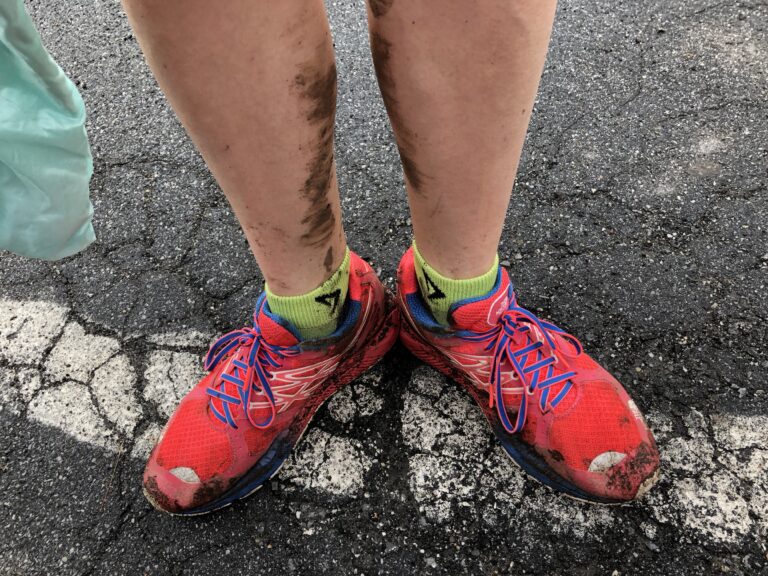
The right gear depends on the race, but nothing should be new on race day. Practice with the shoes, socks, vest, bottles, soft flasks, nutrition, layers, and mandatory gear you plan to use.
Trail shoes are worth considering if the course includes mud, loose rock, steep descents, or technical terrain. For smooth dirt and gravel, road shoes with decent grip may be enough. The best choice is the shoe that matches the surface and that you have tested on long runs.
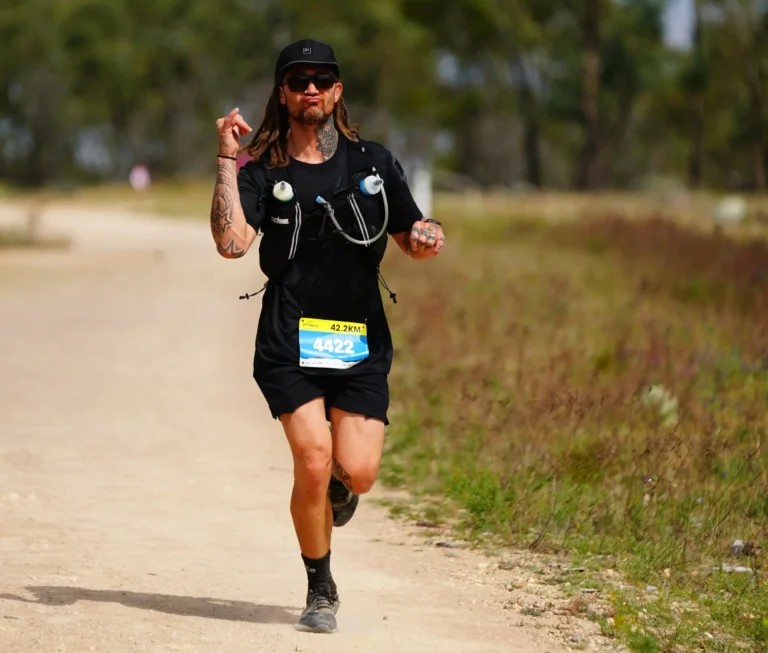
Most trail marathons require you to carry more than a road marathon: hydration, calories, a phone, basic emergency items, and sometimes a jacket or first-aid supplies. Read the race rules early so you can train with the full setup.
A hydration vest is not mandatory for every race, but it is often the cleanest solution. It lets you carry soft flasks, food, layers, and emergency items without stuffing everything into shorts pockets. Practice with it when it is full, not only when it is light.
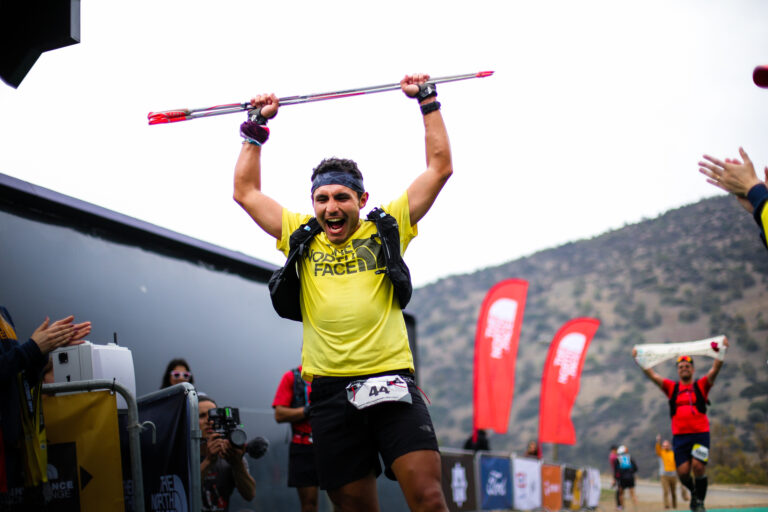
Poles are course-dependent. For a runnable first trail marathon, they are often unnecessary. For steep mountain courses, they can help if you know how to use them. Do not bring poles for the first time on race day. They change your rhythm, your hand use, your climbing mechanics, and your aid-station routine.
Weather, Heat, and Altitude
Trail races expose you to conditions that road marathons sometimes avoid. You may spend hours in sun, wind, rain, mud, heat, or altitude. Build the likely conditions into the plan early enough to adapt.
Heat changes pacing and hydration. If your race could be warm, practice some easy runs in warmer conditions, carry fluids on long runs, and learn how your effort changes on exposed climbs. Heat is not only a race-day problem. It is a training variable.
Altitude changes expectations. If the race is high and you live at sea level, you may not be able to fully adapt, but you can still prepare by arriving early if possible, pacing conservatively, and avoiding a course that asks too much for your first trail marathon.
Bad weather changes gear. A light jacket, gloves, a dry layer, or a hat can be the difference between discomfort and a real problem. Mandatory gear lists exist for a reason. Treat them as part of the race, not as paperwork.
Race-Day Strategy for Your First Trail Marathon
Start easier than you think you need to. The first hour often feels comfortable because you are fresh and excited. That is exactly when runners make the mistakes they pay for later.
Use effort, not pace. Keep the early climbs controlled. Power hike steep sections before you are forced to. Eat and drink from the beginning. Let other runners go if they are pushing too hard early. The strongest trail marathon finishes usually come from patient first halves.
On climbs, shorten your stride and keep the effort steady. On descents, stay relaxed and avoid braking aggressively. At aid stations, do the simple things well: refill fluids, take food, check your body, and leave with what you need for the next section.
Expect a low point. Almost every long trail race has one. A rough patch does not mean the race is over. It may mean you need calories, fluids, electrolytes, shade, a few minutes of hiking, or simply patience. Training teaches you how to respond instead of panic.
The last 10 kilometers of a trail marathon are usually where the early decisions show up. If you started conservatively, fueled early, protected your quads, and stayed patient on climbs, you give yourself a real chance to finish strong.
Race Segment | Effort | Main Job |
Start to 10K | RPE 4-5 | Stay patient, eat early, and ignore faster starters. |
Middle section | RPE 5-6 | Keep climbs controlled and protect the legs on descents. |
Final third | Effort by feel | Solve problems early and keep moving steadily. |
Aid stations | Calm and efficient | Refill, eat, check gear, and leave with enough for the next section. |
Common Trail Marathon Training Mistakes
The first mistake is training like it is a road marathon. Road fitness helps, but it does not solve hills, descents, technical terrain, gear, fueling, or longer time-on-feet. If the plan never leaves flat surfaces, it is missing the point.
The second mistake is chasing mileage at the expense of recovery. Trail running can be slower and still harder. If you add miles because your weekly total looks low, you may stack fatigue faster than you realize.
The third mistake is ignoring descents until race day. Downhill running is a skill and a muscular demand. If your race has long descents, prepare for them.
The fourth mistake is leaving nutrition to instinct. Most runners eat too late when they are new to trail racing. Practice early fueling until it becomes automatic.
The fifth mistake is choosing too hard a first race. There is nothing wrong with ambition, but a runnable first trail marathon will teach you more and usually set up a better long-term relationship with the sport.
Tapering for a Trail Marathon
The final two weeks should protect freshness. You are not trying to gain fitness anymore. You are trying to absorb the work.
Two weeks out, reduce volume but keep some short touches of intensity, such as strides or brief hill efforts. Race week should feel light. Easy running, mobility, sleep, logistics, and gear checks matter more than adding one more workout.
Do not make up missed training during the taper. If the block was imperfect, that is normal. Arriving healthy and rested is more valuable than squeezing in a panic long run.
Recovery After a Trail Marathon
Give yourself more recovery than you would after a flat road race. The downhill load and extra time-on-feet can leave your quads sore for days or weeks.
The first week should be easy: walking, sleep, food, mobility, and no pressure to run. In the second week, return to easy running only if your legs feel normal on stairs and gentle descents. If soreness lingers, wait. Recovery is part of the training process.
If you finish your trail marathon and want the next step, a 50K is the natural progression. The distance is only a little longer, but the training and race-day skills you build here transfer directly.
─ Vert Pro · Vert Coaching: Designed and approved by expert coaches.
Trust the training.
Then trust race day.
Build Your Trail Marathon Training Plan with Vert.run
A trail marathon plan should not be generic. Your course, elevation gain, terrain, race date, training history, weekly availability, injury background, and goals all matter.
Vert.run builds training around the race you are actually preparing for. That means time-on-feet instead of blind mileage, RPE instead of road pace, terrain-specific work when it matters, and coach-backed structure that adapts when life interrupts the plan.
That adaptability matters because trail training rarely goes perfectly. Weather changes, work gets busy, legs get sore, and access to terrain is not always predictable. A useful plan should help you make the next good decision, not punish you for missing one session.
The goal is simple: arrive at the start line with enough fitness, enough durability, enough practice, and enough confidence to handle the course in front of you.
Tell us your race date and goals. We will help you get to the start line ready.
Frequently Asked Questions
How long should a trail marathon training plan be?
Most runners should plan for 14 to 18 weeks. Fourteen weeks can work if you already have a strong running base and trail experience. Sixteen to 18 weeks is better if you are coming from road running or preparing for a hilly course.
Do I need to run a road marathon before a trail marathon?
No. You need a consistent running base and enough time to adapt to trail terrain. Being able to run 80 to 90 minutes easily is a better starting marker than having a road marathon result.
How many miles per week should I run?
Use time first. Many trail marathon plans build toward 4 to 7 hours per week, depending on experience and race difficulty. Mileage can be misleading because trail terrain changes the training load.
What is the longest run before a trail marathon?
For most runners, 2.5 to 3.5 hours is enough. The goal is to practice terrain, gear, fueling, and time-on-feet without creating excessive fatigue.
Can I use a road marathon plan?
Only as a starting point. You still need hill work, downhill preparation, strength training, RPE-based pacing, gear practice, and long runs that match the terrain.
What pace should I train at?
Train by effort. Most easy runs and long runs should feel like RPE 4 to 5 out of 10. Trail pace varies too much with terrain to be the main guide.
What should I eat during a trail marathon?
Start with 200 to 300 calories per hour, plus fluids and electrolytes. Practice the plan on long runs and avoid new foods on race day.
Do I need trail shoes?
It depends on the course. Smooth dirt and gravel may be fine in road shoes with grip. Mud, loose rock, steep descents, or technical terrain usually call for dedicated trail shoes.
Finished your trail marathon and thinking about what comes next? Here’s how Vert runners take the step up: The Ultimate 50k Training Guide.
─ Vert Pro · Vert Coaching: Designed and approved by expert coaches.
You have the distance covered.
Now let’s build the training around it.