A 200, 240 or 250-mile ultramarathon is not simply a longer 100-mile race. The extra time changes how you need to train, pace, eat, sleep, care for your feet, use your crew, and solve problems as fatigue builds.
A good 200+ mile training plan develops more than aerobic fitness. It prepares you to keep moving efficiently, make sensible decisions after several days on the course, and deal with small problems before they become race-ending ones.
This guide gives experienced ultrarunners a practical framework for preparing for 200, 240 and 250-mile races. It covers the training timeline, weekly structure, long runs, back-to-backs, terrain, strength, nutrition, sleep, crew planning, foot care, tapering, and race execution.
It is not a fixed schedule for every runner. Your current training, injury history, race terrain, available time, and recovery capacity should determine the final plan.
About this guide
I have coached several athletes for 200-mile races and have completed a 300-mile race myself. The biggest lesson from both sides is that 200-plus miles is almost a different sport. Fitness matters, but it is far from the only factor that decides whether the race goes well.
What happens at mile 120 does not predict what will happen at mile 180. Sleep loss, foot problems, nutrition, temperature, and accumulated fatigue can create situations you have never experienced in a shorter ultra. Training has to prepare you to manage that uncertainty, not only cover a certain number of miles.
─ Vert Pro · Vert Coaching: Designed and approved by expert coaches.
Have a race?
Tell us and we’ll build your training plan around it.
Quick answer: how should you train for a 200-mile race?
Ideally, give yourself about six months for a focused 200-mile build. You may be able to prepare in less time if you already have a strong base, but the real advantage of a longer build is consistency. You can accumulate many solid weeks instead of relying on a few extreme peaks.
Training should combine consistent easy running, hiking, long efforts, carefully placed back-to-back and three-day blocks, race-specific terrain, strength work, nutrition practice, night running, gear rehearsals, recovery weeks, and a two- to three-week taper.
The goal is not to chase the biggest possible mileage number. The goal is to build durable fitness and repeatedly practice the systems you will rely on when you are tired: eating, drinking, pacing, sleeping, changing layers, caring for your feet, and communicating with your crew.
A complete 200 mile training plan should include:
- Consistent easy running and hiking across the week
- Long runs that rehearse fueling, gear, pacing, and foot care
- Selected back-to-back long-run weekends
- Terrain and elevation practice matched to the race
- Strength training for climbing, descending, and carrying a pack
- Planned recovery weeks
- Night running without deliberate extreme sleep deprivation
- Crew, drop-bag, and aid-station rehearsals
- A taper that reduces fatigue while preserving routine
Who should train for a 200-mile ultramarathon?
A 200-mile race is usually not a sensible first ultramarathon. You do not need to be fast, but you do need enough experience to understand how your body and mind respond after many hours on your feet.
You do not need a huge racing resume or dozens of ultramarathon finishes. Ideally, you should have experienced at least one 100-mile race because it gives you direct experience with overnight movement, prolonged fueling, foot care, pacing errors, and deep fatigue.
Multi-day hiking and fastpacking projects also count. Someone who does not race often but has spent several consecutive days moving through difficult terrain may be better prepared than their race history suggests.
Before beginning a focused 200-mile build, you should ideally have:
- Several years of consistent running or endurance training
- Experience completing at least one long ultra, with 100-mile experience preferred, or substantial multi-day hiking experience
- A weekly training routine you can sustain without recurring injury
- The ability to hike efficiently on climbs and runnable terrain
- A tested nutrition and hydration routine
- Experience training and moving at night
- Enough time for long training blocks and the recovery they require
- A realistic plan for work, family, travel, sleep, and general life stress
If your current training is inconsistent or you are returning from injury, rebuild that foundation first. Extending the preparation period is usually more useful than forcing race-specific work into a body that is not ready to absorb it.
For a broader introduction to ultra distances and progression, read Vert’s ultramarathon guide. If you are still building toward the distance, the 50K training guide, 100K training plan, and 100-mile training guide provide more appropriate stepping stones.
What makes 200 miles different from 100 miles?
The main difference is time. A 100-mile race may involve one very long day and night. A 200-mile race can continue across several days, with more weather changes, more sleep pressure, more foot swelling, and far more opportunities for small problems to compound.
That changes the priorities. Aerobic fitness, climbing strength, and long-run durability still matter, but systems become just as important:
- How often you eat when appetite drops
- When you change socks, shoes, and layers
- How you respond to hot spots and blisters
- How you decide whether to sleep
- How your crew prepares each stop
- How you manage pace when you still feel fresh
- How you adapt when the original plan no longer fits
At 200 miles, the cost of ignoring a small problem is higher. A hot spot left untreated can become a major foot issue. Underfueling early can make the second or third night far harder. Starting too quickly can leave you unable to move efficiently long before the final third.
This is why race preparation must include logistics and decision-making, not only workouts.
How long should a 200 mile training plan be?
For most experienced ultrarunners, six months is a strong target for a focused 200-mile build. The exact length depends on your recent training, long-ultra experience, injury history, race terrain, and the amount of specific preparation you already have.
The plan may be shorter if you already have a strong base and have recently completed a healthy 100-mile build. It should be longer if you are stepping up from shorter ultras, returning from a break, or preparing for terrain that is very different from where you normally train.
Phase | Typical length | Main purpose |
Foundation | 6 to 10 weeks | Rebuild consistency, easy volume, strength, and basic durability |
Development | 8 to 12 weeks | Extend long efforts, climbing, descending, and weekly time on feet |
Race-specific | 6 to 10 weeks | Practice back-to-backs, nutrition, night running, gear, crew, and race terrain |
Peak | 2 to 4 weeks | Complete the most specific training while protecting recovery |
Taper | 2 to 3 weeks | Reduce fatigue, maintain rhythm, and finalize race logistics |
These phases should overlap rather than behave like completely separate programs. Strength, fueling practice, hiking, and recovery remain important throughout the build. What changes is the emphasis.
How much should you run each week?
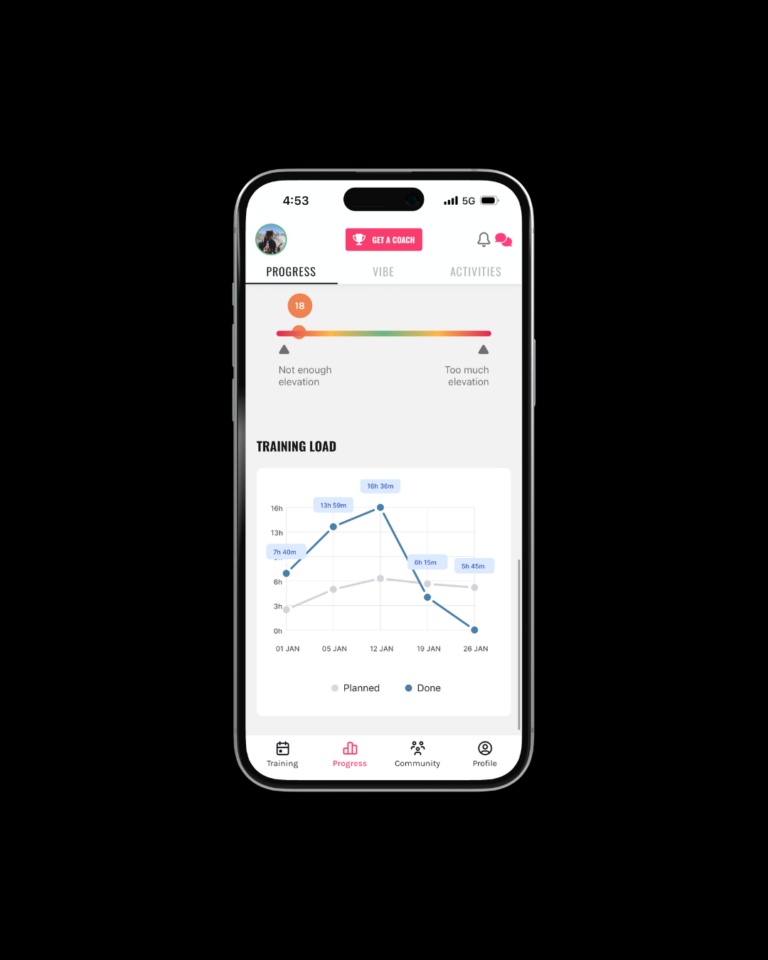
Forget about chasing a universal mileage target. Hours are a more useful measure for 200-mile training.
The pace in a 200-mile race can be extremely slow compared with shorter events. If you judge the challenge by pace or weekly mileage alone, the distance can look deceptively easy. What matters is your ability to keep moving, eating, thinking, and solving problems for a very long time.
Start from the highest volume or training time you have recently sustained while staying healthy. Build gradually from that baseline, and judge the load by how well you recover and repeat the work.
Useful ways to monitor training load include:
- Weekly hours rather than mileage alone
- Vertical gain and loss
- Long-run duration
- Consecutive days on tired legs
- Strength-training load
- Sleep quality and general life stress
- Soreness, mood, appetite, and motivation
Your peak should be relative to your normal training. If you can consistently handle 10 hours per week, a peak of roughly 14 to 16 hours may be appropriate. If your normal sustainable load is closer to eight hours, a peak around 12 hours may be enough.
Those are examples, not targets. The average volume across the full training block matters more than one impressive peak week. Multi-day long efforts, hiking, and time on feet are more valuable than forcing mileage that does not match the race.
If your easy pace is slowing for several weeks, sleep is deteriorating, soreness is changing your stride, or every session feels like something to survive, reduce the load. A 200-mile build is too long for repeated recovery mistakes.

Long runs and back-to-back training
Long runs teach far more than endurance. They are opportunities to practice pacing, fueling, hydration, foot care, clothing, poles, pack setup, and problem-solving.
For 200-mile training, a long run should be treated as a rehearsal rather than a test. Finish with useful information, not simply a large number on the watch.
Back-to-back long efforts can help you learn to move on tired legs without relying on one enormous training run. They also let you practice eating and recovering between days.
Useful structures include:
- A long trail run followed by a long hike the next day
- Two moderate long days with similar terrain and steady effort
- A daytime long run followed by a shorter night session
- A climbing-focused day followed by easier time on feet
- A race or supported training event followed by an easy recovery hike, when appropriate
Three-day blocks can be especially useful when your training history supports them. They let you practice waking up and moving again after two accumulated days of fatigue, which is much closer to the reality of a 200-mile race. Use them deliberately because the recovery cost is high.
Do not always train at your preferred time of day. Run in the morning, afternoon, evening, and at night. Force yourself to solve the practical problems that appear when you move outside your normal routine.
Avoid stacking difficult back-to-backs when soreness is changing your movement, sleep has been poor, or you have not recovered from the previous block. The training benefit comes from absorbing the work, not merely completing it.
Train for the actual terrain
A 200-mile race can include long climbs, sustained descents, technical trail, mud, heat, altitude, road connectors, and large gaps between aid stations. Your plan should reflect the course rather than using distance as the only guide.
If the race has long climbs, practice efficient power hiking. If it has sustained descents, develop downhill control and leg durability. If it contains long runnable sections, practice holding an easy effort without drifting too fast. If the trail is technical, spend time moving smoothly over uneven ground while tired.
Runners without regular mountain access can still prepare through treadmill climbing, stairs, strength work, local hills, hiking, and repeated time-on-feet sessions. Vert’s guide to training for hills without mountain access gives practical substitutes.
Heat, cold, altitude, and wet conditions should also influence the build. Use Vert’s heat training guide if high temperatures are likely, and test every layer you expect to use before race week.
How to adapt this plan for a 200, 240 or 250-mile race
The distance on the race logo is a starting point, not the training prescription. A 240 or 250-mile event adds time, but course profile, technicality, heat, altitude, crew access, cutoffs, and the likely number of nights out can matter more than the extra miles.
Use this guide as the framework for a 200-plus-mile race, then make the race-specific block answer the questions the actual course creates. That includes events such as Mammoth 200, Moab 240, Cocodona 250, and the 330 km TOR330 Tor des Géants, but this is not a substitute for the current official course guide, race rules, crew instructions, or medical requirements for your event.
Before the race-specific block, write down:
- The real course distance and expected time on feet, including a conservative late-race estimate
- Total climbing and descending, plus the longest sustained climbs and descents
- How technical or runnable the terrain is likely to be
- Heat, cold, altitude, storms, water crossings, dust, or other conditions you are likely to face
- The longest section between aid or crew access, and what you must carry through it
- Expected start time, likely first and second nights, and safe sleep options
- Pole, pacer, crew, drop-bag, navigation, and mandatory-gear rules
Then change the emphasis—not the whole plan. A very mountainous race needs more hiking economy, climbing strength, downhill durability, and time carrying the full race pack. A highly runnable course needs more controlled all-day running and restraint early in the race. A hot course needs practiced heat management and a nutrition plan that still works when appetite drops. A race with sparse crew access needs more self-sufficient long-run rehearsals.
For a 240 or 250-mile race, extend the specific preparation only when you can absorb it. Usually that means a little more race-specific time on feet, more deliberate multi-day rehearsal, and a more detailed sleep-and-crew plan—not one huge training run or a reckless simulation of the full distance. Keep the final plan grounded in the workload you can repeat and recover from.
─ Vert Pro · Vert Coaching: Designed and approved by expert coaches.
Have a race date?
Tell us and we’ll build your training plan around it.
Strength training for 200-mile races
Strength training supports climbing, descending, hiking, pack carrying, and the repeated impact of several days on foot. It should make the running plan more sustainable, not compete with the most important endurance sessions.
Useful priorities include:
- Single-leg strength and control
- Calf and foot strength
- Glute and hip stability
- Trunk strength
- Posterior-chain strength
- Step-ups and hiking-specific strength
- Controlled eccentric work for descending
One or two short sessions per week can be enough when they are consistent. During peak running weeks, reduce strength volume so you preserve the movement quality without adding unnecessary fatigue.
Vert’s strength training for runners guide explains how to fit this work around running, while the Vert Strength plan provides a structured option.
Nutrition for a 200-mile ultramarathon
Nutrition must be trained. A 200-mile runner needs more than a list of favorite foods. You need a system that still works when you are tired, cold, hot, nauseated, bored with sweet food, or moving more slowly than expected.
Start with the carbohydrate, fluid, and sodium intake you already tolerate during long runs. Increase or adjust it gradually in training instead of introducing an aggressive target on race day. Individual needs vary with body size, effort, temperature, altitude, sweat rate, and gut tolerance.
A useful race nutrition plan answers:
- What will you eat and drink during each hour or course section?
- Which foods work when you are climbing, running, or stopped?
- What options are available at aid stations?
- What will your crew carry?
- How will the plan change in heat or cold?
- What will you use when sweet food becomes unappealing?
- What will you eat after a sleep break?
- What is the backup plan for nausea or a missed aid station?
Variety matters. Test sports nutrition, simple real foods, warm options, salty options, fluids, and backup choices. Keep records after long efforts so you know what worked and what failed.
The Vert Nutrition Planner can help you estimate and organize fueling for long sessions and race day. For more background, read the complete ultramarathon nutrition guide.
Sleep and night running
Sleep is one of the clearest differences between 100 and 200 miles, and people respond to sleep loss very differently. Some runners naturally cope with it better than others.
There is no single sleep strategy that works for every athlete or race. The plan should be built around your previous response to sleep loss, the course, the expected finish time, crew access, and the race rules.
If you already handle night running well, you may only need a few additional sessions to test the race setup. If you struggle at night, this needs to become a meaningful part of your preparation.
The first step is simply getting used to moving at night. Caffeine and other tactics come later. Before relying on them, learn how darkness changes your pacing, appetite, temperature, alertness, and logistics.
Training should not try to reproduce several days of severe sleep deprivation. Instead, use repeated night sessions to practice:
- Headlamp and backup-light setup
- Layer changes as temperatures drop
- Eating late at night
- Hiking or running technical terrain in darkness
- Communicating with crew while tired
- Recognizing when alertness is becoming unsafe
A purposeful overnight or very early morning session can be useful when it is planned safely. Try different start times so you experience evening, midnight, early morning, and sunrise movement. Arrange transport, avoid driving while dangerously tired, and do not turn training into a contest to stay awake.
Caffeine can be useful, but it should support a tested night-running strategy rather than replace one. Practice the timing and dose conservatively before race day, and remember that more is not always better.
For race day, write down the conditions that would trigger a sleep stop or medical assessment. Confusion, loss of coordination, repeated falls, hallucinations, and an inability to stay awake are safety problems, not motivation problems.
Crew, pacers, and aid-station strategy
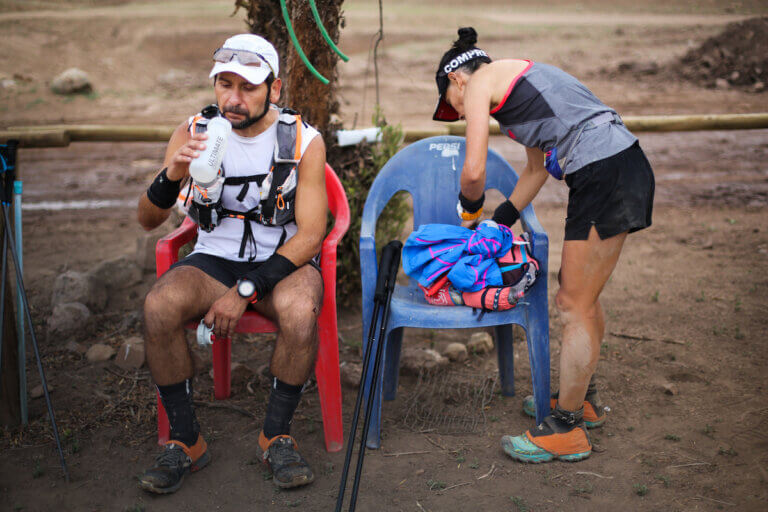
Crew and pacers can reduce decision fatigue, but only when everyone understands the plan. A prepared crew should know what to offer, what to observe, and when to challenge a poor decision.
Before the race, create a simple plan for each crew-access point:
- Expected arrival window
- Food and drink choices
- Bottles or flasks to refill
- Shoe, sock, and clothing options
- Foot-care supplies
- Headlamp and battery changes
- Medication rules agreed with your medical professional
- Sleep options
- Drop-bag contents
- Reasons to seek medical help
Use the same stop routine whenever possible:
- Identify the immediate problem.
- Refill fluids and food.
- Check feet, layers, lights, and required gear.
- Confirm the next section and expected conditions.
- Leave once the necessary work is complete.
Aid stations should be calm and deliberate. Rushing can cause mistakes, but unplanned sitting can turn a short stop into a long one. Give your crew permission to keep the process moving while still treating safety concerns seriously.
Gear, feet, and problem-solving
At 200 miles, you have to become very good at getting ahead of problems. Foot cleaning, blister management, nutrition, hydration, layering, and lacing can all look minor at first, but the race gives them a long time to become serious.
Foot care deserves specific rehearsal. Shoes, socks, swelling, wet conditions, dust, river crossings, lacing, and long descents can all change how your feet behave.
Your race kit should account for:
- Primary and backup shoes
- Socks for different conditions
- Blister treatment and skin protection
- Headlamp, backup light, and battery plan
- Rain and cold layers
- Heat protection
- Pack fit and organization
- Poles when allowed and useful
- Course-required safety equipment
Do not assume that sizing up is automatically the correct shoe strategy. Test shoes late in long sessions when your feet are warm and slightly swollen. A shoe that is too loose can create movement and blisters, while a shoe that is too tight can create pressure and toenail problems.
Treat hot spots early. Change wet socks when practical. Remove grit. Adjust laces. Take the extra five minutes when something feels wrong. Five minutes spent fixing a lace or an ankle discomfort can save hours later in the race.
Do not frame that time as wasted. In a 200-mile race, preventative stops are part of moving efficiently.
Pacing a 200-mile race
The opening hours should feel controlled. Take things slowly. If the pace feels exciting or heroic, it is probably too fast.
Use effort rather than pace alone. Terrain, heat, altitude, sleep, and aid-station spacing will change your speed throughout the race. Efficient hiking is part of the plan, not evidence that the plan has failed.
A useful pacing principle is to protect the final third. You are not only trying to reach mile 100. You are trying to arrive at mile 150 with enough physical and mental capacity to keep making good decisions.
Do not expect the race to deteriorate in a neat, linear way. Mile 180 can feel completely different from mile 120. Your body may do strange things when you are deeply tired and sleep deprived, and a large part of preparation is accepting that possibility without panicking.
Divide the course into manageable sections. Plan around major climbs, descents, crew points, and sleep opportunities rather than obsessing over an average pace that may be meaningless on varied terrain.
Vert’s Trail Race Time Predictor can help with an initial finish-time estimate, but use it as a planning input rather than a promise. Build generous buffers for aid stations, sleep, weather, foot care, and late-race slowing.
Recovery weeks and warning signs
A 200 mile training plan should include regular lighter weeks. A common pattern is two or three progressive weeks followed by a reduced week, but the schedule should respond to the athlete rather than follow a rigid formula.
A recovery week usually means less volume and less intensity while preserving some easy movement. Strength work may also be shorter or lighter.
Warning signs that should change the plan include:
- Soreness that alters your stride
- A specific pain that is worsening
- Poor sleep across several nights
- Persistent irritability or unusual fatigue
- Loss of appetite
- Repeatedly elevated effort on easy runs
- Declining motivation combined with physical fatigue
- Inability to recover between long-run weekends
Respond early. Replacing a session with rest, reducing a back-to-back, or taking an additional recovery week is usually less costly than losing several weeks to injury or illness.
Sample build week
This example shows the shape of a normal build week. Duration should be scaled to your existing training and race demands.
| Day | Session | Purpose |
| Monday | Rest or short recovery run, plus mobility | Absorb the weekend |
| Tuesday | Easy run with short hill strides | Aerobic consistency and leg speed |
| Wednesday | Medium-long run on rolling terrain | Midweek durability |
| Thursday | Easy run plus strength | Strength and movement quality |
| Friday | Rest or short easy run | Prepare for the weekend |
| Saturday | Long trail run with fueling and gear practice | Specific endurance and rehearsal |
| Sunday | Long hike or easy long run | Time on tired legs |
Most weeks should not feel like peak weeks. The repeatable work between big weekends is what builds the foundation.
For an athlete who normally handles eight hours per week, this structure might build toward roughly 12 hours in selected peak weeks. An athlete who consistently handles 10 hours may eventually reach 14 to 16 hours. The specific number matters less than whether the athlete can absorb it and return to consistent training.
Sample race-specific weekend
Use a race-specific weekend occasionally, after you have developed the base to recover from it.
Day | Session | Focus |
Friday evening | Short night run or hike | Lights, layers, navigation, late fueling |
Saturday | Long terrain-specific effort | Pacing, nutrition, feet, pack, climbing |
Sunday | Moderate hike or easy run | Moving efficiently on tired legs |
The timing can change. One useful version starts early on Friday, runs late on Saturday, and finishes with an early Sunday session. The goal is to experience different times of day and practice the logistics that come with each one.
This is not a prescription to train through extreme exhaustion. Stop or shorten the block if movement quality deteriorates, pain becomes specific, or alertness creates a safety risk.
Tapering for a 200-mile ultramarathon
Most runners will benefit from a two- to three-week taper, with the exact length based on peak training load and personal recovery patterns.
Reduce volume gradually while keeping some short easy running, hiking, and light intensity. The goal is to arrive rested without feeling disconnected from your normal routine.
The taper is also the final logistics phase:
- Confirm crew instructions and contact details
- Pack and label drop bags
- Check required gear
- Replace worn batteries and charge devices
- Review nutrition quantities
- Confirm travel and sleep arrangements
- Prepare backup options for likely weather
Do not introduce new shoes, foods, poles, packs, or sleep strategies late in the taper. Race week should confirm decisions already tested in training.
Common mistakes in 200-mile training
The most common mistakes are usually simple decisions repeated for too long:
- Increasing volume faster than you can recover
- Treating every long run as a performance test
- Using huge training days to compensate for inconsistent weeks
- Focusing on a single peak week instead of the average volume across the block
- Ignoring hiking efficiency
- Training only at your preferred time of day
- Training only in ideal weather and daylight
- Waiting until late in the build to practice nutrition
- Skipping strength until pain appears
- Practicing extreme sleep deprivation instead of purposeful night running
- Delaying crew, gear, and drop-bag planning until race week
- Ignoring hot spots, swelling, or shoe problems
- Assuming a 100-mile strategy will work unchanged for 200 miles
- Refusing to adjust the plan when life stress increases
The best correction is usually not more motivation. It is a clearer system and an earlier decision. Do not let a small, fixable issue become the problem that defines the next 100 miles.
When to work with a coach
A 200-mile race has enough variables that many runners benefit from experienced coaching. A coach can help set an appropriate load, progress long efforts, place back-to-backs, adapt training to the race terrain, and make changes before fatigue becomes a larger problem.
Coaching is especially useful if you are stepping up from 100 miles, returning from injury, balancing a demanding schedule, or training far from the terrain you will race on.
Vert specializes in trail and ultrarunning. You can explore Vert’s trail and ultra coaches if you want a plan shaped around your background, schedule, and race.
Final take
A 200-mile ultramarathon asks for patience long before race day. The training takes time, the logistics matter, and the event will test far more than fitness.
The best 200 mile training plan is not the one with the largest mileage total. It is the one you can repeat, recover from, and use to practice the exact problems the race will create.
Build the aerobic base. Practice the terrain. Train your gut. Protect your feet. Learn to move safely at night. Make the crew plan simple. Give yourself enough time to arrive ready for the full distance, not only the first day.
Most importantly, do this because you are curious about the distance and want to experience the strange, difficult, and occasionally fun parts of it. A 200-miler should not be just another item to tick off a list.
Frequently Asked Questions
How long does it take to train for a 200-mile race?
Ideally, allow about six months for a focused 200-mile build. You may be able to prepare in less time if you already have a strong base, but a longer build allows more consistent weeks without relying on extreme peaks.
How many miles per week should I run for a 200-mile ultramarathon?
Use hours rather than chasing a universal mileage target. Start from a training load you have recently sustained while healthy, then build gradually. Weekly hours, hiking, elevation, multi-day efforts, and recovery are more useful than mileage alone.
Do I need to run 100 miles before training for 200 miles?
A 100-mile finish is not always a formal requirement, but it is strongly recommended. Substantial multi-day hiking or fastpacking experience can also provide relevant preparation for moving, eating, and solving problems across several days.
Should I practice sleep deprivation before a 200-mile race?
Do not use extreme sleep deprivation as routine training. Practice moving at different times of night and learn how darkness changes your pacing, nutrition, layering, logistics, and alertness. Test caffeine only after the basic night-running routine is familiar.
What should I eat during a 200-mile ultramarathon?
Use a practiced plan that includes carbohydrates, fluids, sodium, and enough variety for several days. Individual targets depend on body size, effort, temperature, sweat rate, and gut tolerance, so test and adjust the plan during long training efforts.
Can I train for a 200-mile race without mountains?
Yes, but you need practical substitutes such as treadmill climbing, stairs, strength training, hiking, local hills, and long time-on-feet sessions. Be honest about the gap between your training terrain and the race.
Can a 200-mile plan prepare me for a 240- or 250-mile race?
Yes, when the plan is adapted to the course rather than treated as a generic mileage schedule. Use the extra distance to guide more race-specific time on feet, terrain practice, crew planning, sleep strategy, and self-sufficiency—not a single extreme training run. Confirm current course details and rules with the event organiser.
─ Vert Pro · Vert Coaching: Designed and approved by expert coaches.
Trust the training.
Then trust race day.