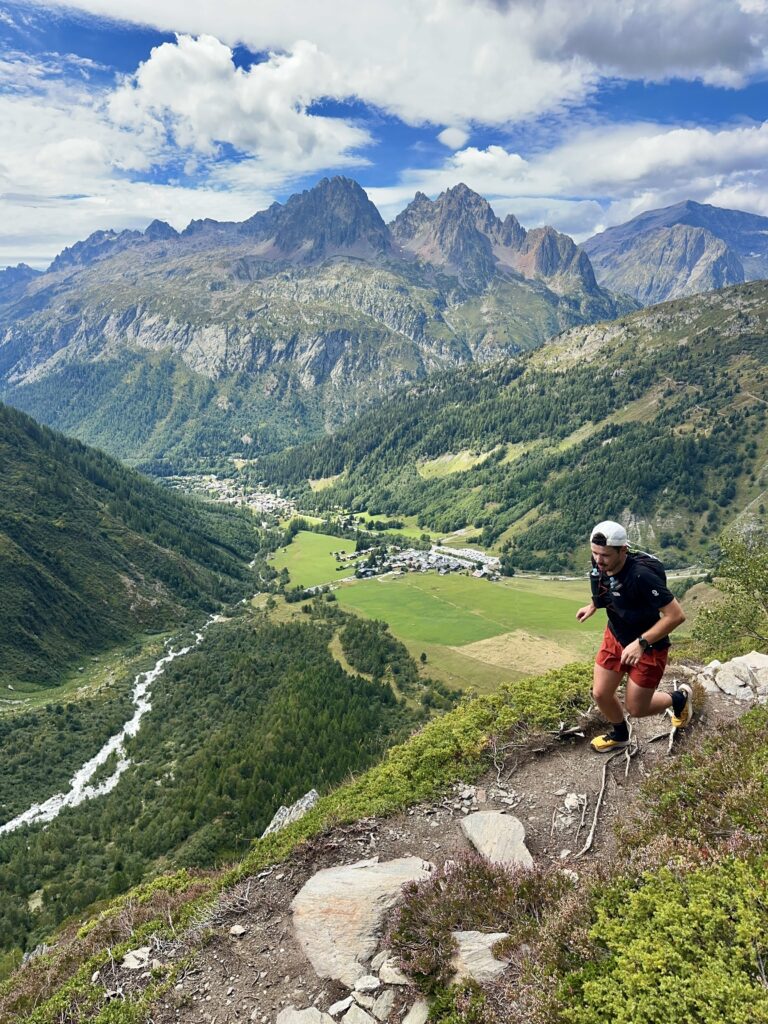
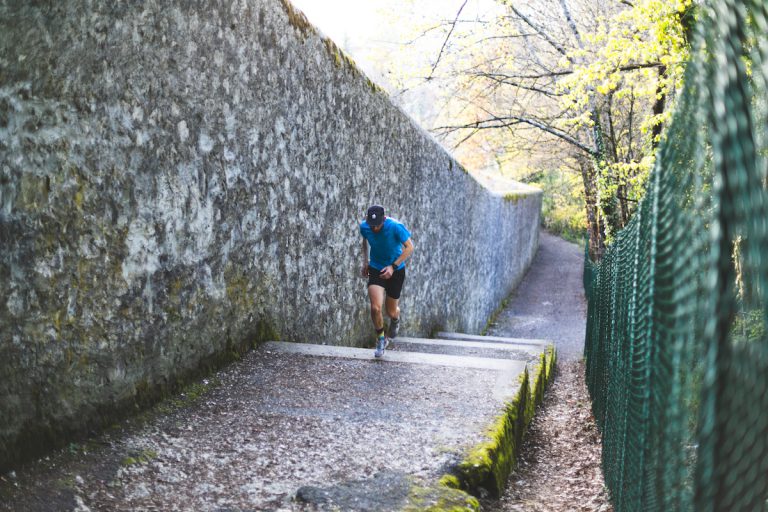
My name is Francesco Puppi. I am a professional trail runner and a coach for Vert.run, and I have helped runners understand how to train for hills without mountains when they live and train in flat places.
If you live in a flat city, you can still prepare well for a race with real climbing.
This guide is for runners training for trail, mountain, and ultra races without regular access to long hills, steep trails, or mountains. Instead of trying to force mountain training onto flat roads, you need the right substitutes: treadmill incline, stairs, strength work, power hiking, and smart race-specific sessions.
The goal is not to copy the mountains perfectly. The goal is to build the climbing strength, downhill resilience, and fatigue resistance your race will demand, using the terrain and tools you actually have.
Today, I am going to show you how to train for hills without mountains, no matter where you live.
Inspiration from Ruth Croft
You do not need mountains outside your front door to become strong on climbs. Many excellent trail runners have prepared for mountain races while living and training in flat cities.
Ruth Croft is a well-known example. While living in Taipei, she did most of her training on flat terrain, then raced extremely well in the mountains. The lesson is not that hills do not matter. It is that smart training substitutions can prepare you far better than most runners think.
This is the key idea: you do not need to recreate the mountains perfectly. You need to train the specific demands of climbing and descending with the tools and terrain you do have.
Even if you live somewhere flat, you can still prepare effectively for a race with serious climbing.
You may not be able to copy the exact elevation profile of your goal race in training. But you can still build the specific strength, muscular endurance, and resilience needed for long climbs and descents.
That is the goal of this guide: not to recreate the mountains perfectly, but to prepare your body for what the mountains will ask of it.
If you live somewhere flat, focus on five things:
- Treadmill incline or stair sessions for uphill-specific strength
- Step-downs and eccentric leg work for downhill resilience
- Strength training for glutes, quads, calves, and core
- Long runs that simulate fatigue, even without major elevation
- Occasional mountain-specific days when you can get to real climbs

How to Train for Hills Without Mountains When You Live Somewhere Flat
How is it possible to improve your uphill and downhill strength even if you live in a city or a flat area?
With some adaptations and creativity, and maybe a little shift in your mindset, you can still train for trail running even if the closest thing to a trail is your local city park.
If you can get to real hills or mountains, use our hill running training guide for uphill and downhill workouts, power hiking, and race-specific terrain practice.
The key point is to understand that running is not always enough.
While you may not be able to replicate the exact vertical gain of the races you have in your calendar, or the ideal elevation prescribed by your training plan, you can mimic the intensity to simulate it and train your muscles to develop almost the same adaptations.
Basic Strength and Conditioning Exercises
Core and strength training should be a staple in every trail runner’s training program, especially if you train in a flat place.
The best exercises are the ones that involve strengthening the muscles recruited while running:
- Squats
- Half squats
- Lunges
- Calf raises
- Step ups
- Bird dogs
- Bridges
Also include non-specific core and strength routines, like planks, crunches, triceps dips, and push-ups. For a deeper routine, use Vert’s strength training for runners guide alongside this hill-specific work.
One interesting and scientifically proven fact about strength is that, no matter what exercise you are doing or which muscle group is involved, your general strength will improve!
Strength Work That Replaces Hill Running
If you live somewhere flat, strength work is not just extra injury prevention. It is one of the main ways you replace the muscular demand of climbing and descending.
Flat running can build your aerobic engine, but it does not fully prepare your legs for the force demands of a mountain race. Uphill running asks more from your calves, glutes, hamstrings, hip flexors and lower back. Downhill running asks even more from your quadriceps because they have to absorb impact while lengthening under load. That eccentric load is why many runners feel fine climbing in a race, then fall apart once the long descents begin.
The goal is not to become a gym athlete. The goal is to build enough durable strength that your trail running form does not collapse when the course gets steep.
Use these exercises as the foundation:
- Step-ups: the closest gym replacement for uphill hiking and climbing. Use a box or bench high enough that your working leg has to drive, but not so high that you push off aggressively with the back foot.
- Split squats or reverse lunges: useful for single-leg strength and control.
- Calf raises: essential for climbing economy, especially if your race has long sustained ascents.
- Single-leg deadlifts: good for hamstrings, glutes and balance.
- Wall sits or slow squats: simple quad strength for long climbs and descents.
- Step-downs: one of the best exercises for downhill resilience.
- Slow downhill lunges: useful if you do not have real descents nearby.
For most runners, two short strength sessions per week are enough. One can be heavier and slower, focused on controlled strength. The other can be lighter and more movement-based, focused on step-ups, lunges, calf raises and core work.
A simple session looks like this:
- Step-ups: 3 sets of 8 to 10 each leg.
- Reverse lunges: 3 sets of 8 each leg.
- Single-leg calf raises: 3 sets of 12 each leg.
- Step-downs: 3 sets of 6 to 8 each leg, slow and controlled.
- Plank or side plank: 3 sets of 30 to 45 seconds.
Keep the first few weeks conservative. If you add too much eccentric work too fast, your legs will be sore in a way that ruins your running. The right strength work should support your running, not compete with it.
─ Vert Pro · Vert Coaching: Designed and approved by expert coaches.
Live in a flat place?
Vert.run coaches build training plans around the terrain you have.
A coach-backed training experience built around the terrain you actually have.
Train for mountain and trail races even if you live somewhere flat, with a plan adapted to your hills, stairs, treadmill access, and race goals.
Running Workouts on Stairs
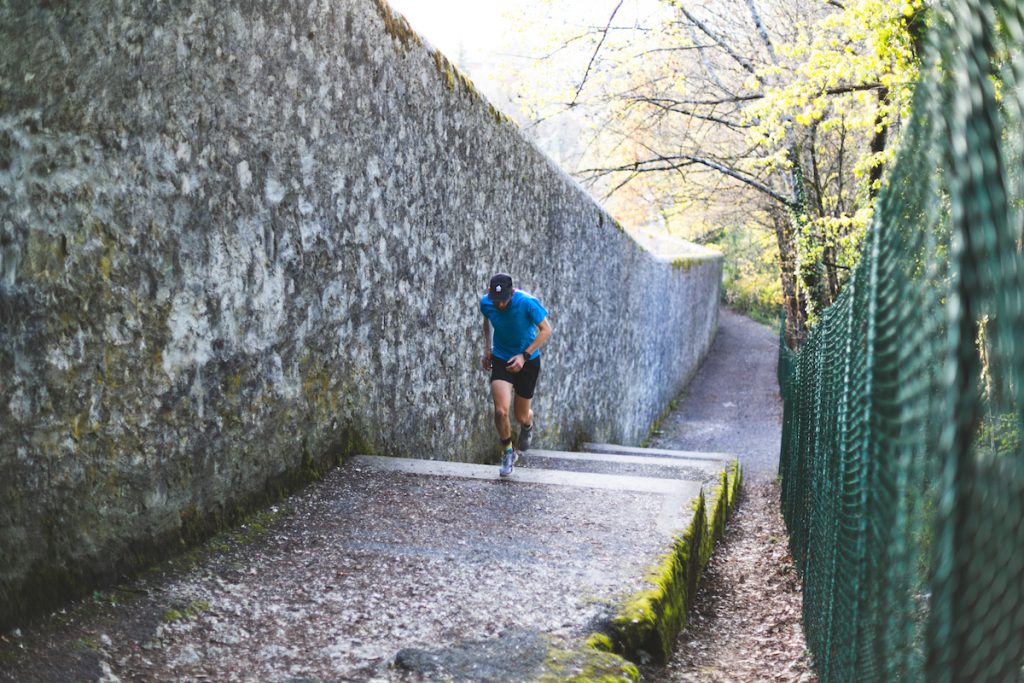
You may not be able to climb a mountain every day, but one of the easiest ways to create real elevation-specific work is running up and down stairs.
While living and training on a cruise ship, pro runner Zach Miller won the JFK 50-mile and Lake Sonoma 50-mile races (in 2013 and 2014 respectively.)
How did he do that? By training on stairs and on a treadmill.
Don’t let living in a flat place hold you back! Make sure you put the time in, stay consistent and follow the principle of progression: running up and down stairs can be a bit mentally daunting, so it’s important to be gradual. Make it fun and take your workout to the next level adding some intensity!
Examples of Running Workouts on Stairs
1. Stair Intervals Plus Progression Run
After a good warm-up (on flat or on the stairs), run 10 x 30 seconds uphill intervals at high intensity (8/10 RPE). You can take one or two steps at a time and even alternate, to give your body different stimuli. Once you’re done, start a progression of 30 minutes beginning with an effort of 4/10, and pushing it a little harder every 5 minutes, ending at tempo pace.
2. Stair Ladder
After a good warm-up, run this ladder two times: 3 min – 2:30 min – 2 min – 1:30 min – 1 min – 30 sec. Recover jogging down the ladder until the start, after each interval. Finish with some flat cool-down.
3. Stair Circuit
Warm-up and then run 4 floors of stairs up and down, adding a core, strength or HIIT exercise each time you are at the bottom (examples: burpees, plank, push-ups, wall sit, jumps, lunges). Continue for 30 minutes continuously.
Jumps and Plyometric Work
Jumps are a great way to strengthen your muscles, improve your reactivity and work on your downhill skills.
There are many ways to do jumps:
- Rope jump,
- Box jumps,
- Jump lunges,
- Jump squats,
- Plyometric jumps.
The key is quality over quantity. Start with small amounts, stay consistent, and you will soon notice the improvements.
I suggest starting with low impact exercises (such as the rope jump and box jumps) and then, once you get stronger, also thanks to the other strength and conditioning routines that you should be taking care of, continue to the more advanced exercises.
Treadmill Incline Training Basics
Some love it, some hate it: but no matter how you feel, a treadmill is definitely the most accurate simulation of uphill running.
You can virtually do any uphill workout with the treadmill: uphill tempo, uphill intervals, hilly runs, uphill strides…and it’s a very easy, useful way to train for the trails even if you live in a city (or you don’t have the possibility to run outside because it’s dark, icy or for other reasons).
Some treadmills can go up to a 30% grade or even more!
A couple of disadvantages: you cannot simulate the downhill, of course, and the foot strike is always the same. This tends to put more stress on your feet and ankles, so make sure you mix it with some running outside, even on flat ground, and include foot-strengthening exercises.

Treadmill Incline Training That Actually Works
The treadmill section above covers the basics well. Here are three specific protocols you can plug directly into your training week. Before choosing which one to prioritize, look at your race profile. If your race has long, sustained climbs, lean toward the tempo protocol at lower effort. If your race has shorter, punchier climbs, lean toward the interval protocol at higher effort. Specificity matters even on a treadmill.
Sustained climb tempo: Set the treadmill to 8 to 10% incline. Run for 20 to 40 minutes at RPE 6 to 7, a comfortably hard effort you can sustain without stopping. This simulates the long, steady climbs you will face in a mountain race. Start at 20 minutes and build by 5 minutes each week. Best for runners whose races feature long, continuous ascents.
Incline intervals: Set the treadmill to 10 to 15% incline. Run 8 to 12 x 1 minute at RPE 8, walking or jogging flat for 90 seconds between each. This trains your cardiovascular system to handle the intensity spikes of shorter, punchier climbs. Best for runners whose races feature repeated short climbs rather than one big sustained effort.
Progressive hilly run: Set the treadmill to 6% incline and run easy for 10 minutes at RPE 4. Every 5 minutes, increase the incline by 2%. Continue until you reach 14 to 16%, then reverse back down the same way. Total session is 40 to 50 minutes. This mimics the undulating elevation profile of a trail race better than a flat sustained climb and works well regardless of your specific race profile.
One useful addition to any treadmill session: once you finish the incline work, step off the treadmill and do 15 to 20 minutes of flat outdoor running immediately after. Your legs will already be fatigued from the climbing effort, and running flat on tired legs simulates the feeling of reaching a runnable section mid-race when your quads have already taken a beating. It is a small addition that adds meaningful race-specific stimulus.
One important reminder from Francesco’s note above: the treadmill cannot train your downhills. Complement every treadmill block with eccentric leg work, slow downhill lunges and step-downs, to build the quad resilience your race will demand on the descents.
Other Gym Tools for Hill Training
In the gym, you will find a wide range of possibilities to improve your uphill and downhill strength. Besides the treadmill, the weights and classic gym equipment, here are a few machines that you can use:
- The Stairmaster, where you can basically replicate all the stair and treadmill workouts
- The elliptical: a wonderful way to add aerobic volume and intensity + strength without the injury risk of running (it’s a low impact activity)
- The rowing machine: for resistance training and general strength, using all major muscle groups
StairMaster for hill training
A StairMaster is a useful flat-city substitute for sustained climbing work, especially when you do not have access to long hills or an incline treadmill. It can help build the stepping strength and aerobic endurance needed for power hiking, but it will not replace downhill conditioning or real trail footing.
For three practical sessions, progression guidance, and help fitting StairMaster work around your race training, see our StairMaster workouts for trail runners.

How to Progress Hill Training When You Live Somewhere Flat
The biggest mistake flat-city runners make is trying to solve the elevation problem in one heroic workout. They do a huge stair session, a hard treadmill climb, or a long Stairmaster workout, then need several days to recover. That is not good training. It is just a hard day.
You will improve faster by progressing one specific elevation stimulus each week.
Start with one focused hill-replacement session per week. That session can be stairs, treadmill incline, Stairmaster, or a gym strength session built around step-ups and lunges. Keep the rest of the week normal: easy running, one quality run if appropriate, strength, and a long run.
Once your body handles that rhythm, progress in this order:
- Increase duration first. Add 5 to 10 minutes to the session before you make it harder.
- Increase total climbing work second. Add a few more intervals, another stair repeat, or a longer steady Stairmaster block.
- Increase intensity last. Only push harder once your legs are already handling the volume.
Here is a simple four-week progression:
Week | Main hill-replacement session | Goal |
|---|---|---|
1 | 8 x 45 seconds stairs or treadmill incline | Learn the movement, finish fresh |
2 | 10 x 1 minute stairs or treadmill incline | Add volume without forcing intensity |
3 | 6 x 2 minutes at moderate-hard effort | Build sustained climbing strength |
4 | 30 to 40 minutes steady Stairmaster or incline tempo | Extend the effort |
After week four, take a lighter week or return to shorter intervals. Do not build forever. Hill strength improves when you repeat the stimulus consistently and recover well enough to absorb it.
If your race is close, your progression should become more specific. A runner training for a steep 50k should prioritize power hiking, step-ups, and treadmill incline. A runner training for a runnable trail marathon should use shorter hill intervals, strides, and leg speed. A runner training for a 100k or 100-miler needs more muscular endurance, so the long Stairmaster or incline tempo sessions become more important.
Running Workouts in Sand
Running in the sand is a great way to build uphill strength when you live in a flat place.
The added resistance of running in the sand will help simulate the effort required for climbing hills.
In the sand, you’ll want a shorter stride, an increased cadence and more arm pumping to stay balanced, similarly to uphill running.
If the sand is compact enough, you can keep your shoes on. But if the sand is deep or soft, why not try running barefoot too? It’s a great proprioceptive exercise (use the principle of progression, in duration and intensity.)
Intensity
Running uphill is hard. It puts the cardiovascular and muscular systems into stress: that’s why you need to train your body to adapt to a similar intensity.
Combining intensity workouts with strength work on a regular basis will be the key to your success while training in a flat place.
Our bodies perceive exertion based on physiological parameters like heart rate and breathing rate, so we can simulate that hard effort with a flat, fast workout such as an interval training session, a fartlek, or a tempo run.
Besides this, as we mentioned, it’s important to keep our bodies strong and efficient with strength work, which also helps keep us healthy and more injury resistant.
Mixing Different Components
What makes the difference is the mix of different components: strength and conditioning, intensity, and cross-training.

How to Use the Mountain Index to Make Your Elevation Work Count
If you are trying to estimate what your race will demand, use the Vert Race Time Predictor to compare distance, elevation gain, and course profile before choosing your key workouts.
The Mountain Index is simple: total elevation gain divided by total distance. A race with 3,000m (10,000ft) of gain over 50km (31 miles) has a Mountain Index of 60m per km. It is one of the most useful tools for trail runners to understand what a race actually demands beyond just the distance.
For flat-city runners, the honest reality is this: on a week-to-week basis, your Mountain Index will always be lower than your race demands. That is just the nature of training where you live. The tools in this article, stairs, treadmill, Stairmaster, sand, get you closer than doing nothing, but they will not fully close the gap on their own. That is fine. You do not need to match your race Mountain Index every week to be prepared.
Where the Mountain Index becomes genuinely useful for flat-city runners is in two specific situations.
The first is designing treadmill and Stairmaster sessions. If you know your race MI, you can calculate exactly how much elevation gain you need to accumulate in a given session to make it race-relevant. A 60 minute treadmill session at 10% incline running at 6km per hour gives you roughly 600m of gain over 6km, a MI of 100. That single session, done once a week, starts to move the needle in a meaningful way.
The second is planning your mountain trips. If you can get to real terrain once or twice during your sharpening phase, use the MI to design those days intentionally. Find a route whose MI closely matches your race. That day becomes your most specific training stimulus of the entire block. One well-designed mountain day at the right MI is worth more than weeks of flat running with occasional stair sessions.
So the approach for a flat-city runner is not to chase the MI every week. It is to use the MI to make your specific elevation sessions count, and to design your mountain trips so that when you do get there, you are replicating exactly what your race will demand.
Match Your Hill Training to Your Race Distance
Not every trail race asks for the same kind of hill fitness. A short, steep mountain race, a runnable 50k, and a 100-mile ultra all require different versions of climbing strength.
For a trail marathon or 50k, the priority is usually efficiency. You need to be able to run or power hike climbs without spiking effort too early, then return to normal running once the trail flattens out. Treadmill intervals, stair repeats, and short hill-style efforts work well here. Keep the workouts controlled enough that you can still run well the next day.
For a 100k, the priority shifts toward durability. You still need climbing strength, but you also need to keep moving after several hours on your feet. This is where longer Stairmaster sessions, incline tempo runs, and back-to-back weekend work become useful. One day can provide the climbing stimulus; the next day teaches you to run on tired legs.
For a 100-miler, the priority is patience and repeatability. Most runners will hike large parts of the climbs, even if they are strong runners. That means power hiking is not a fallback. It is a race skill. Practice it directly. Use the Stairmaster, steep treadmill hiking, weighted hiking only if appropriate, and long easy efforts where the goal is steady output instead of speed.
Those pages help runners understand how hill training fits into the bigger training block for their race distance.
How can I replace a hill workout if I don’t have access to the hills?
This is a question I often get from the athletes here at Vert.run, especially the new ones who are just discovering trail running and wonder how the heck they can train for a mountain trail race while living in a flat city.
There are many ways to replace a hill workout with another type of training, which of course won’t produce the exact same effect but which will still be very useful to build your fitness.
Hill Workout Substitutes That Work
- If you don’t have access to a longer climb, a set of “short” uphill intervals, as long as 2 or 3 minutes, will work.
- For example, 6 x 3 minutes uphill @ 7 RPE, or 12 x 1 minute uphill @ 8 RPE (depending on what is available), jogging back downhill as a recovery.
- A set of hill strides or hill sprints, on a short, steep incline (as short as 60m or 200ft).
- You can run two or three sets, each one including 6 to 8 hill sprints which should be run close to your maximum speed. Jog or walk back down to the start of the climb after each sprint, and recover for 2 or 3 minutes after each set.
- A stair workout.
- Often, especially if you live in a city, you’ll have the possibility to run a few floors and this might be the easiest way to get in some elevation gain if you live in a city.
- People in the building might think that you’re a bit…different, but it’ll be totally worth the effort! If you need to make the session harder, bound up the stairs two or three steps at a time.
- A treadmill workout:
- The treadmill gives you the possibility to set the grade of the incline and control the effort very precisely, with the only disadvantage being that it’s an extremely even surface. You can replicate a continuous climb, a set of uphill intervals, a hilly run, or alternating short climbs with some sections of flat running.
- A cross-training session:
- If you have access to a gym, you can take advantage of the stair master, which is great for conditioning the legs. Another example, if you have a bike or a stationary bike, work at low cadence and hard gear to simulate a climb: it’ll make for a great strength and intensity workout.
- You can go climbing, do a CrossFit session, a HIIT, or strength and conditioning workout with a PT
- A core and strength workout (in the gym or at home, with or without weights.)
- This is technically not a replacement for a hill session, but something that should be included in your typical training week all year. It’s still worth mentioning!
─ Vert Pro · Vert Coaching: Designed and approved by expert coaches.
You’re already thinking like a trail runner.
Now let’s build a plan around the terrain you actually have.
A coach-backed training experience built around the terrain you actually have.
Train for mountain and trail races even if you live somewhere flat, with a plan adapted to your hills, stairs, treadmill access, and race goals.
Sample Training Week for a Flat-City Runner Preparing for a Mountain Race
This is an example of what a solid training week looks like for a runner based in a flat city, 8 weeks out from a 50k mountain race with significant elevation gain. This is a sharpening phase week, not a base building week.
Monday: Rest or 30 minutes easy cross-training (bike or elliptical). Active recovery only.
Tuesday: Treadmill incline intervals. 10 x 1 minute at 12% grade, RPE 8. Rest or walk for 90 seconds between each – no need to adjust the incline, just stop or walk in place. 15 minute warm-up and cool-down at easy pace. Total: 50 to 60 minutes.
Wednesday: Easy flat run, 50 to 60 minutes at RPE 4 to 5. Add 4 to 6 strides at the end, 20 seconds each at 80% effort with full recovery between. These keep your legs sharp and your running economy from going flat during a high-volume training block.
Thursday: Strength and core session, 40 to 45 minutes. Squats, lunges, step-ups, single-leg deadlifts, calf raises, plank variations. For a flat-city runner this is not optional. Thursday strength work is as important as any running session in the week.
Friday: Rest or very easy 20 to 30 minute jog. Legs should feel fresh going into the weekend.
Saturday: Long run, 2 to 2.5 hours. Use every elevation source available: stairs, treadmill incline sections, any real hills nearby. Target 60 to 70% of your race Mountain Index on this day. Practice your race nutrition and gear.
Sunday: Stairmaster or easy run, 50 to 60 minutes at RPE 4 to 5. Running on tired legs from Saturday. Keep the effort honest but do not push it.
Total week: approximately 6 to 7 hours of moving time.
How to Know If Your Hill Training Is Working
You do not need mountains nearby to measure whether your hill training is improving. Track a few simple signals every two to four weeks.
First, watch your effort at the same treadmill incline or Stairmaster level. If the same 30-minute incline session feels easier, or your heart rate is lower at the same pace and grade, your climbing economy is improving.
Second, watch your recovery. Early in a hill block, stairs and eccentric strength work can leave your legs heavy for a day or two. Over time, the same session should create less soreness. That is a sign your legs are adapting to the muscular demand.
Third, test your power hiking. Choose a repeatable session, like 20 minutes on the Stairmaster or treadmill at 12 to 15% incline. Keep the effort steady. If you can cover more vertical work at the same perceived effort, you are moving in the right direction.
Finally, pay attention to how your flat runs feel after climbing work. In a race, the climb is not the only problem. The real test is whether you can run normally after the climb. If you can finish a treadmill or stair session and then run 15 to 20 minutes flat with decent form, that is a useful sign.
The goal is not to perfectly simulate the mountains. The goal is to arrive at your race with legs that recognize the work.
A week like this requires knowing how to balance intensity, volume, and recovery in the right proportions. The further you go in distance, the more that balance matters and the harder it is to manage on your own. A 50k demands a certain level of preparation. A 100k or 100-miler demands significantly more, and the cost of getting the balance wrong compounds with every extra hour on the course. This is where working with a Vert coach can make a real difference. A coach builds your week around the terrain you actually have, adjusts your plan when life gets in the way, and makes sure you arrive at your start line ready.

Frequently Asked Questions: Training for Hills Without Mountains
What is the single most beneficial session for a flat-city trail runner?
If I had to pick one, it would be a stair or treadmill interval session combined with strength work on the same day. Something like 10 x 30 seconds at high effort on stairs or treadmill at 8 to 10% incline, followed by 20 minutes of squats, lunges and calf raises. This combination trains your cardiovascular system, your uphill-specific muscles, and your general leg strength all in one session. Done consistently once a week, it will make a bigger difference than any amount of flat easy running.
Does doing more reps of shorter hills have the same effect as one long climb?
Not exactly the same, but close enough to be very useful. A long climb trains your ability to sustain effort over time and builds mental endurance for the mountains. Short hill repeats train explosive power, running economy and cardiovascular intensity. The good news is that for most trail runners who live in flat places, short repeats are actually the more important of the two, because they build the strength and efficiency that carries over to race day, even on long climbs. Use the long climb when you can get to the mountains. Use the short repeats every week at home.
How do I prepare my legs specifically for mountain running?
Three things done consistently: hill or stair intervals for uphill-specific strength, eccentric exercises like slow downhill lunges and step-downs for downhill resilience, and a weekly strength routine targeting glutes, quads and calves. Your legs need to be strong enough to absorb the impact of downhills, not just power the uphills. Most flat-city runners train the climbing and forget the descending, and that is where races are lost.
Is a treadmill a good substitute for real hills?
Yes, and it is one of the best tools available to a city-based trail runner. Set the incline to 8 to 15% and you can replicate almost any uphill workout: tempo efforts, intervals, progressive climbs. The main limitation is that you cannot train the downhill, and the surface is always even, which puts repetitive stress on the same muscles. To compensate, mix treadmill sessions with outdoor running even if it is flat, and keep your strength and jumps routine in place to build the leg resilience that technical downhills demand.
How long before my race should I try to get to the mountains for a specific training day?
Ideally at least once in the final six weeks before your race. A big mountain day three to four weeks out, either a long run or a race on similar terrain, is the best way to test your preparation and identify any gaps. If you can only get to the mountains once, make it count: match the elevation profile of your race as closely as possible and practice your nutrition, gear and pacing strategy on that day.
Conclusion
It is important to remember that not every trail runner lives with steep mountains outside the door. That is normal.
A huge number of the athletes I coach through Vert.run do not have daily access to trails or hills. Part of the work is helping them discover that they can train for, finish, and even excel at mountain trail races with the right structure.
Sure, living and training where big climbs are available would be ideal. But now you know how to become a stronger trail runner even without regular access to the hills.