RPE vs heart rate zones: how we convert them
This is the conversion we use when you export a Vert session to your watch with heart rate. Your watch applies it to the heart rate zones you’ve set on it, so the beats per minute are yours.
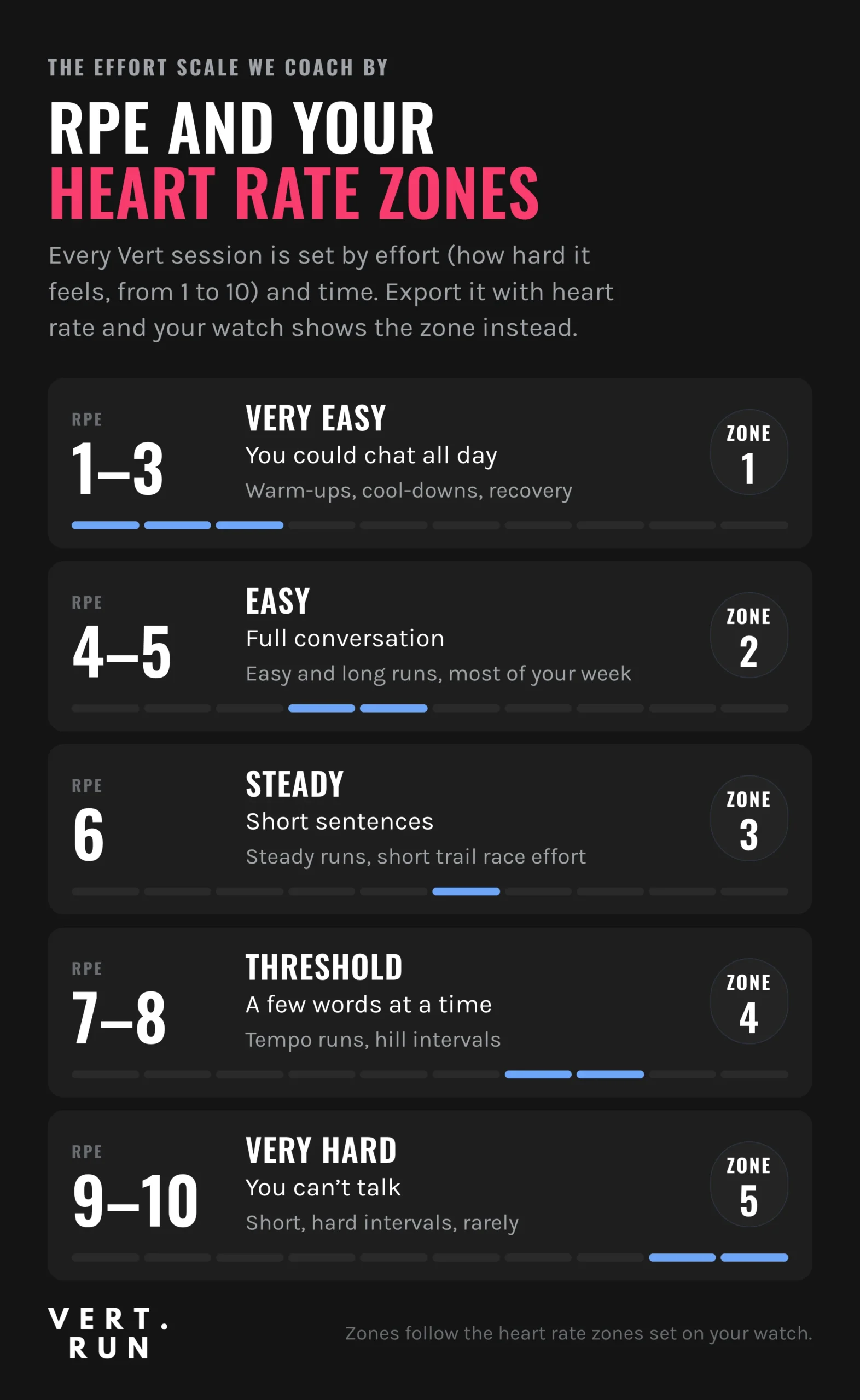
| RPE | How it feels | Typical sessions | Heart rate zone |
|---|---|---|---|
| 1 to 3 | Very easy, you could chat all day | Warm-ups, cool-downs, recovery | Zone 1 |
| 4 to 5 | Comfortable, full conversation | Easy runs, long runs | Zone 2 |
| 6 | Steady, short sentences | Steady runs, race effort on a short trail race | Zone 3 |
| 7 to 8 | Hard but controlled, a few words at a time | Threshold work, tempo runs, hill intervals | Zone 4 |
| 9 to 10 | Very hard to all out, you can’t talk | Short, hard intervals, used sparingly | Zone 5 |
The RPE ranges and sessions are the ones we use in Vert plans. If your zones feel off, check them on your watch first: the conversion is only as good as the zones it maps to.
How to calibrate RPE with your heart rate
- Start on flat ground. On your next easy run, settle at a conversational effort (RPE 4 to 5) and note your heart rate after 15 to 20 minutes. It should sit in zone 2. That’s your easy-day reference.
- Watch a climb. On a steady climb, hold the same effort and see how long your heart rate takes to rise. That delay is why you lead with RPE on hills.
- Check late in long runs. Compare your heart rate in the last hour with the first hour at the same effort. The gap is your drift.
- Keep notes for a few weeks. You’ll soon know when your heart rate is telling you something useful, and when it’s just noise.
How Vert plans use effort
Years ago we could have built our plans around pace and distance, like most running apps. We chose effort, and we’ve stuck with it. Every session in a Vert plan is set by RPE and time, because on a trail the terrain decides your pace, so we coach the effort. Each week your plan also gives you a Mountain Index target, the metres of climbing per kilometre that match your race.
Prefer training by heart rate?
You can. Export your Vert sessions to your watch with heart rate and each step shows up as a heart rate zone instead of an RPE, using the zones you’ve set on your watch: RPE 1 to 3 becomes zone 1, 4 to 5 zone 2, 6 zone 3, 7 to 8 zone 4 and 9 to 10 zone 5. Your watch syncs with the app (Garmin, Suunto and COROS). Just don’t let the number override what your body and the terrain are telling you, especially on climbs.
Race day: effort first
Race day is where heart rate fools runners most. Excitement, heat, altitude and the first climb all push it up. Chase a zone and you’ll either back off for no reason, or miss that you’re working too hard on a climb because your heart hasn’t caught up yet.
So race by effort, and match it to how long you’ll be out there:
- A short trail race, like a 20 km: you can sit around RPE 6 to 7, working but controlled, and push the last climbs if you have something left.
- A 50k: mostly RPE 4 to 5, with some climbs at 6. Going out at 6 or 7 in the first hours is one of the most common reasons runners struggle at the end.
- An ultra, like an 80 km: most of the day should feel like RPE 3 to 4, as easy as your easy runs or easier. Climbs will push it up for a while; bring it back down at the top. If it feels like a 6 in the first hours, you’re going too hard, whatever your watch says.
The longer the race, the lower your effort. Use heart rate as a guardrail, not a target.
RPE vs heart rate: FAQ
Is RPE better than heart rate for trail running?
For most trail running, yes, as your main guide. RPE reacts instantly to climbs, descents and technical terrain, while heart rate lags and drifts with heat, altitude and fatigue. Heart rate is still useful as a check on easy days and for spotting fatigue.
What heart rate zone is RPE 5?
Zone 2. When you export a Vert session to your watch with heart rate, RPE 4 to 5 becomes zone 2, based on the heart rate zones set on your watch. It’s easy, conversational running.
Why is my heart rate so high on climbs?
Climbing is hard work, and heart rate keeps rising for a minute or two after your effort changes. Heat, altitude and fatigue push it higher still. Settle your effort by RPE and let your heart rate catch up.
Should I use heart rate on race day?
Use it as a guardrail, not a target. Race-day heart rate runs high with excitement, heat and altitude. Most trail runners pace better by effort, with heart rate as a check.
Can I train by heart rate with Vert?
Yes. Export your sessions to your watch with heart rate and each step appears as a heart rate zone, using the zones set on your watch: RPE 4 to 5 becomes zone 2, RPE 6 zone 3, and so on.
Can I use RPE and heart rate together?
Yes. Lead with RPE, especially on hills and technical terrain, and use heart rate to keep easy days easy and to spot fatigue trends over weeks.